Beatitudes, Belief, Christianity, Community, Courage, Culture, Faith, Grace, Hope, Jesus, Listening, Neighbors, Quotes, Racism, Relationships, Responsibility, Social Justice, Spirituality, Stories, Thoughts From the Porch, Uncategorized

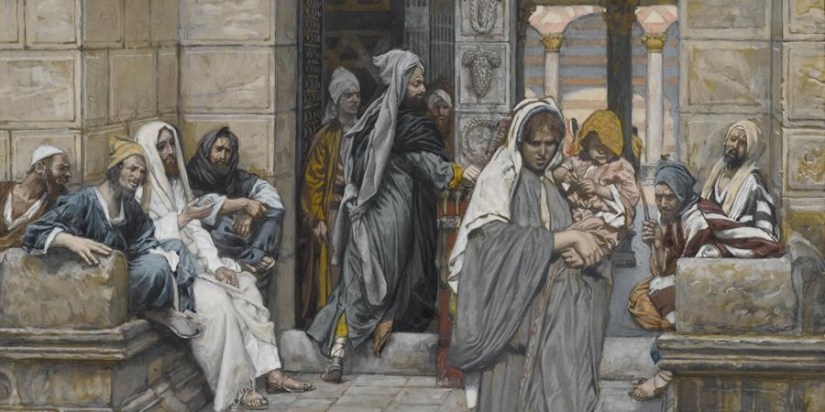
Those of us who live in the West and experience the privilege of being white tend to gloss over the important fact that Jesus lived in an occupied territory. He was not part of the dominant culture. – Fr. Richard Rohr

Thoughts From the Porch

Like many people, I probably fall into the “spiritual, not religious” polling category these days. I still claim membership to a large non-denominational church that used to wear the name “Church of Christ”, but I rarely attend anymore. Even though there are many things I love about my faith tradition, I find myself uncomfortable in a place where “white, suburban, middle-class” continues to be the dominant member demographic.

To be fair, my church tries to be inclusive and has always been welcoming of everyone. They serve both the local and global community. It’s just that for the most part, most of the congregants are white. That’s what happens when you’re located in a predominantly white suburb. It’s the whole “birds of a feather” thing. It’s not intentional, or is it?

The issue of race and racism in my church began to rise to the surface last year. Although it saddens me that it took so long to come up, the minister took a bold leap and preached a series on race. For most of those of the Caucasian persuasion this meant having to discuss racism and race, particularly in the church, for the first time. I applaud their efforts. Quite frankly, white people are extremely uncomfortable talking about such subjects. They deny the problem like an alcoholic denies their alcoholism. It requires a level of honest appraisal that most folks shy away from. Ripping off the intellectual bandages to reveal an ugly, festering wound is painful, but necessary to heal properly. That’s why I was excited to see them offer a seminar “Let’s Start Talking About Race”. At least they’re talking, right?
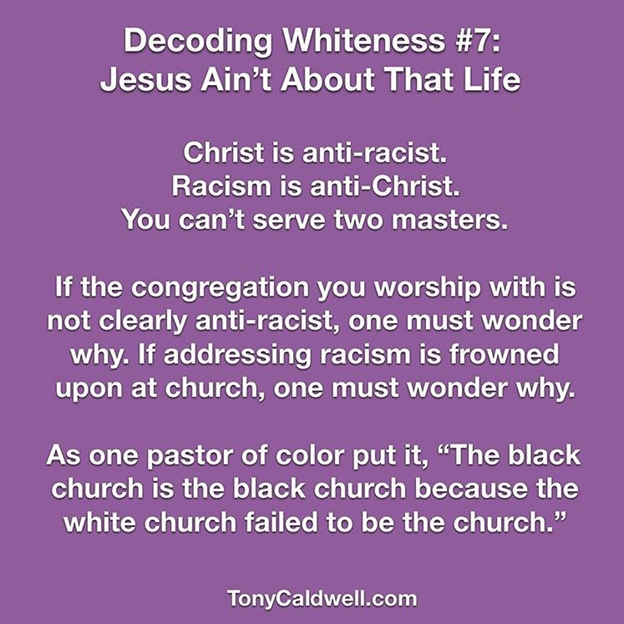
Excellent Resource @ http://www.tonycaldwell.com

“In Christ’s family there can be no division into Jew and non-Jew, slave and free, male and female. Among us you are all equal. that is, we are all in a common relationship with Christ. Also, since you are Christ’s family, then you are Abraham’s ‘descendant’, heirs according to the covenant promises”. Galatians 3.28-29 – The Message

My biggest fear is that my church will stop at ‘talking’ about the problem. My friend, Jim, always told me that “when all was said and done, more would be said than done”. Like the alcoholic who sees the reality of their alcoholism, the church is left with a choice: either continue the destructive behavior or take an active part in the healing process. Action is often simple, but far from easy. Honestly, most of us choose an easier way. That’s scary and a bit hopeless. The good news is we don’t have to do it alone.

I don’t pretend to have the answers. I know however, that relationships are the key, especially ones with people of color. Several years ago, I was working for a local ministry on a community garden on the heart of Como, a predominantly African American and neglected, low income community here in Fort Worth.

During the first days of tilling, building beds, and planting, a guy who rode his bike past the garden each day, stopped and asked why we were tearing up the vacant lot where old downtown Como used to be. I explained to him what we were doing – building a garden that would serve the community. His response was unexpected.

“You white folks come down here and tell us what’s good for our neighborhood as if you know better than us. Your white church comes down here for a few days to help us poor black folk so you can feel better about yourselves and tell everyone to look and see what you did. Then you go back to your nice comfy suburbs and leave us to clean up the mess”.

I thought for a moment, looked him in the eye, and said, “You’re right, but I’m not going anywhere. I’ll be here tomorrow and the day after that.” He grunted and rode off down the street.

What the gentleman passing by didn’t know was that I was working for a neighborhood ministry. Still, I learned something that day. Good intentions hide the fact that we’re still a part of the systemic racism that plagues our society. We don’t listen to communities of color because we think we know better. We think know better because of our implicit bias that says the dominant white culture is ‘normal’ so it must be right. What is that but white supremacy. Ouch…

Several days later, the same guy began to say hello as he rode past each morning. This continued for a few mornings until one day he stopped to ask what “that was coming up over there?” We began a conversation and he introduced himself as Stephen. I introduced myself and we talked about what else was coming up. A couple of days after that his stops became more frequent.

He spoke of the rich history of the land I’d planted, how the neighborhood movie house had been there and how the old downtown had been a vibrant gathering place for the community. He began to stop regularly and chat, asking how things were going. His initial combative attitude changed to one of neighborliness.

The lesson I learned from all of this is that we begin to see each other differently when we spend time with each other. People cease to be ‘them’ and divisions begin to break down. That’s hard to do in a place, especially a church, that lacks diversity – diversity of thought, color, and culture. Unfortunately, Dr. King was right – “It is appalling that the most segregated hour of Christian America is eleven o’clock on Sunday morning.” That lesson has been reinforced many times over the years. I’ve had to take a long, hard, honest look at myself in the process.

I’ve had to identify the old tapes and the old ways of thinking I grew up with. I had to be honest enough to admit my shortcomings and ask God to remove them. I had to repent, or rethink, my old ideas and actions.

I love the word repent. Acknowledging the problem is the first step to a solution, whether it be in spiritual or worldly matters. Jim always told me that once I identify the problem I’m halfway to the solution. Repentance is full of hope and possibility – for all of us.

As I have said, I don’t know all the answers and I’m certainly no expert on racial issues However, I know everything has a beginning. Honest conversation (and listening is the key to conversation) is a great place to start. Just don’t stop there and start walking…

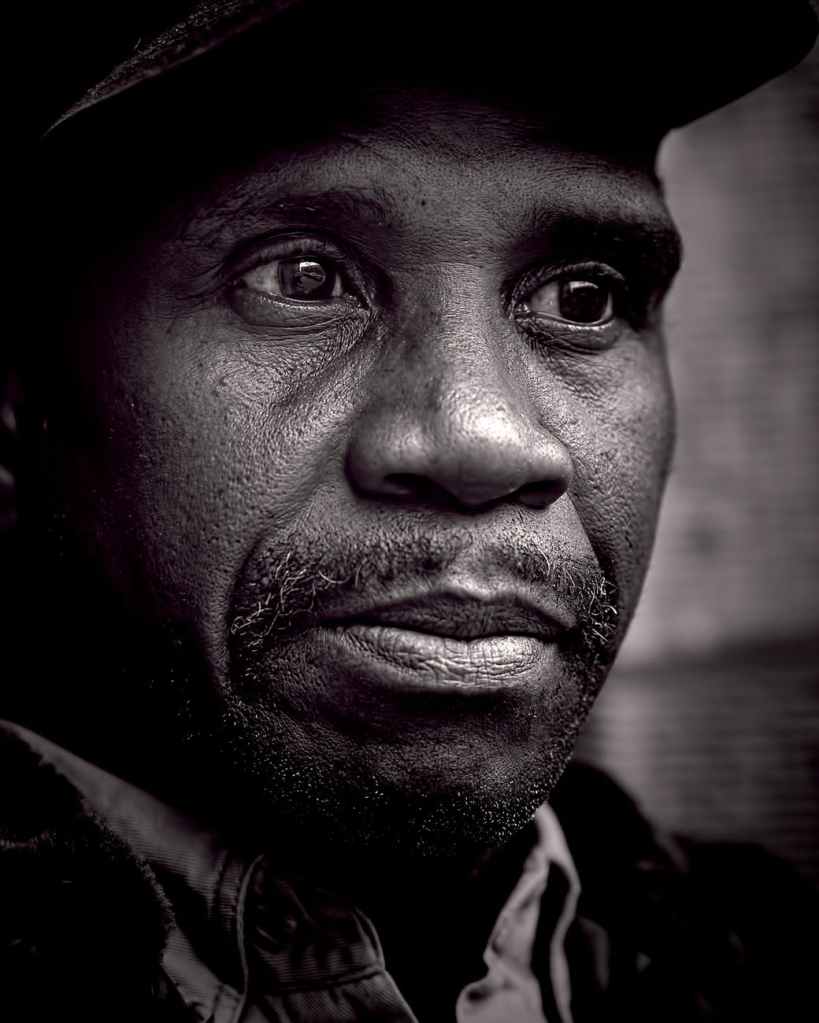
Image credit The Angelus (detail), Jean-François Millet, 18571859, Musee d’Orsay, Paris, France.
Beatitudes, Belief, Bible, Christianity, Community, Culture, Faith, Fighting Poverty, God's Economics, Grace, Hope, Persistence, Practice, Prayer, Red Letter Christians, Simplicity, Social Justice, Songs, Spirituality, Thoughts From the Porch, Uncategorized, What Can I Do

Are You in the Nineteen Percent…

I found this in my inbox over the weekend and wanted to share it. Too often, “Christian” music lacks substance. My friend Jim once told me the difference between a hymn and a worship song was that a hymn tells a story. A praise song simply repeats the same refrain and hallelujah over and over.

This was different. I’m often embarrassed to say I’m a “evangelical” Christian (I prefer “Jesus follower” anyway…). It usually conjures images of ultra-conservative, right-wing Christians that are more interested in one’s sexual preferences than loving others. That’s one of the major reasons I despise labels. I definitely don’t fit the stereotype.

I am evangelical in the dictionary definition of the word; “to be zealous in advocating something”. I’ve found some good news I pass on to others. According to Jesus, “loving God and loving others” pretty much sums up the Good News.

I guess the other 81% are equally evangelical as well, just in a different and extremely unappealing way. I guess that’s why this song hit home. Give it a listen, think about the words, and know there’s a lot of people out there who simply love God and love others. I guess church is where we find each other…

Beatitudes, Belief, Bible, Christian Mysticism, Christianity, Community, Faith, Friendship, Grace, Honor, Hope, Peace, Practice, Quotes, Relationships, Revival, Serenity, Service to Others, Simplicity, Social Justice, Spirituality

“Either we see Christ in everyone, or we hardly see Christ in anyone.”

Adapted from Richard Rohr, “Powering Down: The Future of Institutions,” “The Future of Christianity,” Oneing, vol. 7, no. 2 (Center for Action and Contemplation: 2019), 46-47.

Photo by Pixabay on Pexels.com
Beatitudes, Belief, Bible, Christian Mysticism, Christianity, Culture, Faith, Gifts, God's Economics, Grace, Gratitude, Prayer, Quotes, Relationships, Simplicity, Social Justice, Spirituality, Transformation, Uncategorized

A New Economy…

Thoughts From the Porch: A gorgeous Fall day greeted me this morning as I stepped out on the porch. Every day is gorgeous in my mind, but this morning was especially bright and inviting. My “porch time” has included an email series I’ve been receiving from the Center for Action and Contemplation. I’ve always appreciated Father Richard Rohr and I hope you will appreciate today’s meditation as well.

Richard Rohr’s Daily Meditation

From the Center for Action and Contemplation

Week Forty-eight

Economy: Old and New

The Gospel Economy
Sunday, November 24, 2019

Jesus said to the host who had invited him, “When you hold a lunch or dinner . . . invite the poor, the crippled, the lame, the blind; and blessed indeed will you be because of their inability to repay you.” —Luke 14:12-14

I’d like to begin this week’s meditations by contrasting two economies or worldviews. The first economy is capitalism, which is based on quid pro quo, reward and punishment thinking, and a retributive notion of justice. This much service or this much product requires this much payment or this much reward. It soon becomes the entire (and I do mean entire!) frame for all of life, our fundamental relationships (even marriage and children), basic self-image (“I deserve; you owe me; or I will be good and generous if it helps me, too”), and a faulty foundation for our relationship with God.

We’ve got to admit, this system of exchange seems reasonable to almost everybody today. And if we’re honest, it makes sense to us, too. It just seems fair. The only trouble is, Jesus doesn’t believe it at all, and he’s supposed to be our spiritual teacher. This might just be at the heart of what we mean by real conversion to the Gospel worldview, although few seem to have recognized this.

Let’s contrast this “meritocracy,” punishment/reward economy—basic capitalism which we in the United States all drink in with our mother’s milk—with what Jesus presents, which I’m going to call a gift economy. [1] In a gift economy, there is no equivalence between what we give and how much we get. Now I know we’re all squirming. We don’t like it, because we feel we’ve worked hard to get to our wonderful middle-class positions or wherever we are. We feel we have rights.

I admit that this position satisfies the logical mind. At the same time, if we call ourselves Christians, we have to deal with the actual Gospel. Now the only way we can do the great turnaround and understand this is if we’ve lived through at least one experience of being given to without earning. It’s called forgiveness, unconditional love, and mercy. If we’ve never experienced unearned, undeserved love, we will stay in the capitalist worldview where 2 + 2 = 4. I put in my 2, I get my 2 back. But we still remain very unsure, if not angry, about any free health care (physical, mental, or spiritual) or even free education, even though these benefits can be seen as natural human rights that support and sustain peoples’ humanity. All too often, we only want people like us to get free health care and education and bail outs.

Brothers and sisters, you and I don’t “deserve” anything, anything. It’s all a gift. But until we begin to live in the kingdom of God instead of the kingdoms of this world, we think, as most Christians do, exactly like the world. We like the world of seemingly logical equations. Basically, to understand the Gospel in its purity and in its transformative power, we have to stop counting, measuring, and weighing. We have to stop saying “I deserve and deciding who does not deserve. None of us “deserve”! Can we do that? It’s pretty hard . . . unless we’ve experienced infinite mercy and realize that it’s all a gift.

Gateway to Presence:
If you want to go deeper with today’s meditation, take note of what word or phrase stands out to you. Come back to that word or phrase throughout the day, being present to its impact and invitation.

[1] “A gift economy, gift culture, or gift exchange is a mode of exchange where valuables are not traded or sold, but rather given without an explicit agreement for immediate or future rewards. This contrasts with a barter economy or a market economy, where goods and services are primarily exchanged for value received. Social norms and customs govern gift exchange.” (https://en.wikipedia.org/wiki/Gift_economy)

Adapted from Richard Rohr, “Capitalist Economy and Gift Economy,” Homily (September 1, 2019), https://cac.org/podcasts/capitalist-economy-and-gift-economy/.

Image credit: Le Denier de la Veuve (The Widow’s Mite) (detail), James Tissot, between 1886 and 1894, Brooklyn Museum, Brooklyn, New York.

Activism, Beatitudes, Belief, Bible, Christianity, Faith, Love, Peace, Politics, Quotes, Red Letter Christians, Responsibility, Service to Others, Social Justice, Spirituality

Faith is Action

“Jesus wasn’t executed because he went around healing people; he was crucified as the worst kind of criminal because his Gospel message was viewed as dangerous by the ruling class. In fact, the entire Gospel of Luke is one long lesson in speaking truth to power—to the corrupt elite in Jerusalem. If we Christians claim to have anything to do with Jesus, then we must inherently be engaged with the political issues of our time.” – Peter Armstrong

Photo by Markus Spiske temporausch.com on Pexels.com