I'm the Farm Manager for Opal's Farm - a non-profit5 acre urban farm in Fort Worth that grows for neighborhoods denied access to fresh, nutritious produce through food apartheid. I firmly believe that not only is healthy food a human right, it is also what brings us together Everyone has a seat at the table!
“When I use the word spiritual, I am not contradistinguishing it from the material. I have little patience with any philosophy or religion that seeks to transcend the material realm. Indeed, the separation of the spiritual from the material is instrumental in our heinous treatment of the material world. So when I speak of meeting our spiritual needs, it is not to keep cranking out the cheap, generic, planet-killing stuff while we meditate, pray, and prattle on about angels, spirit, and God. It is to treat relationship, circulation, and material life itself as sacred. Because they are.” – Charles Eisenstein
Thoughts From the Porch: A gorgeous Fall day greeted me this
morning as I stepped out on the porch. Every day is gorgeous in my mind, but
this morning was especially bright and inviting. My “porch time” has included an
email series I’ve been receiving from the Center for Action and Contemplation.
I’ve always appreciated Father Richard Rohr and I hope you will appreciate
today’s meditation as well.
Richard Rohr’s Daily Meditation
From the Center for Action and Contemplation
Week Forty-eight
Economy:
Old and New
The Gospel Economy
Sunday, November 24, 2019
Jesus said to the host who had
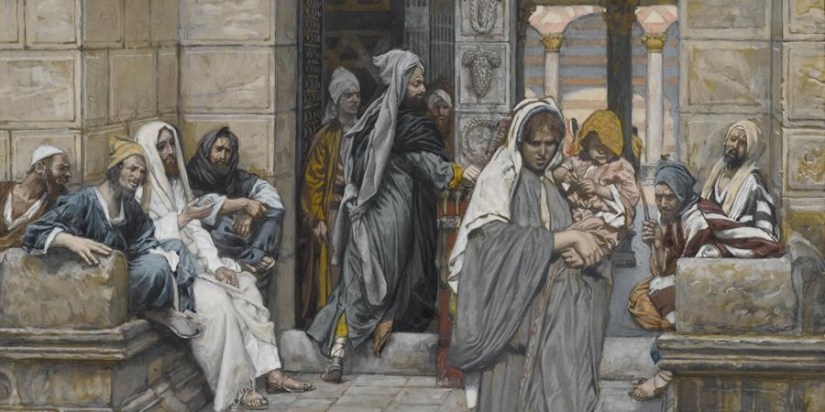
invited him, “When you hold a lunch or dinner . . . invite the poor, the
crippled, the lame, the blind; and blessed indeed will you be because of their
inability to repay you.” —Luke
14:12-14
I’d like to begin this week’s meditations
by contrasting two economies or worldviews. The first economy is capitalism,
which is based on quid pro quo, reward and punishment thinking, and a
retributive notion of justice. This much service or this much product requires
this much payment or this much reward. It soon becomes the entire (and I do mean entire!) frame for
all of life, our fundamental relationships (even marriage and children), basic
self-image (“I deserve; you owe me; or I will be good and generous if it helps
me, too”), and a faulty foundation for our relationship with God.
We’ve got to admit, this system of
exchange seems reasonable to almost everybody today. And if we’re honest, it
makes sense to us, too. It just seems fair. The only trouble is, Jesus doesn’t
believe it at all, and he’s supposed to be our spiritual teacher. This might
just be at the heart of what we mean by real conversion to the Gospel
worldview, although few seem to have recognized this.
Let’s contrast this “meritocracy,”
punishment/reward economy—basic capitalism which we in the United States all
drink in with our mother’s milk—with what Jesus presents, which I’m going to
call a gift economy. [1] In a gift economy, there is
no equivalence between what we give and how much we get. Now I know we’re all
squirming. We don’t like it, because we feel we’ve worked hard to get to our
wonderful middle-class positions or wherever we are. We feel we have rights.
I admit that this position
satisfies the logical mind. At the same time, if we call ourselves Christians,
we have to deal with the actual Gospel. Now the only way we can do the great
turnaround and understand this is if we’ve lived through at least one
experience of being
given to without earning.
It’s called forgiveness, unconditional love, and mercy. If we’ve never
experienced unearned, undeserved love, we will stay in the capitalist worldview
where 2 + 2 = 4. I put in my 2, I get my 2 back. But we still remain very
unsure, if not angry, about any free health care (physical, mental, or
spiritual) or even free education, even though these benefits can be seen as
natural human rights that support and sustain peoples’ humanity. All too often,
we only want people like us to get free health care and education and bail outs.
Brothers and sisters, you and I
don’t “deserve” anything, anything. It’s all a gift. But until we begin to live
in the kingdom of God instead of the kingdoms of this world, we think, as most
Christians do, exactly like the world. We like the world of seemingly logical
equations. Basically, to understand the Gospel in its purity and in its
transformative power, we
have to stop counting, measuring, and weighing. We have to stop saying “I deserve” and deciding who does not deserve.
None of us “deserve”! Can we do that? It’s pretty hard . . . unless we’ve experienced
infinite mercy and realize that it’s
all a gift.
Gateway to Presence: If you want to go deeper with today’s
meditation, take note of what word or phrase stands out to you. Come back
to that word or phrase throughout the day, being present to its impact and
invitation.
[1] “A gift economy, gift culture, or gift exchange is a mode of
exchange where valuables are not traded or sold, but rather given without an
explicit agreement for immediate or future rewards. This contrasts with a
barter economy or a market economy, where goods and services are primarily
exchanged for value received. Social norms and customs govern gift exchange.” (https://en.wikipedia.org/wiki/Gift_economy)
Down On the Farm: Fall is a busy time at Opal’s Farm. There
is winter produce such as Kohlrabi, cabbage, and spinach and cover crops to be
planted. There’s rebuilding beds and design changes to be made for Spring, irrigation
infrastructure to be built, and the ever-persistent weeds and grasses to be
dealt with. I only wish the Bermuda grass did as well at my house!
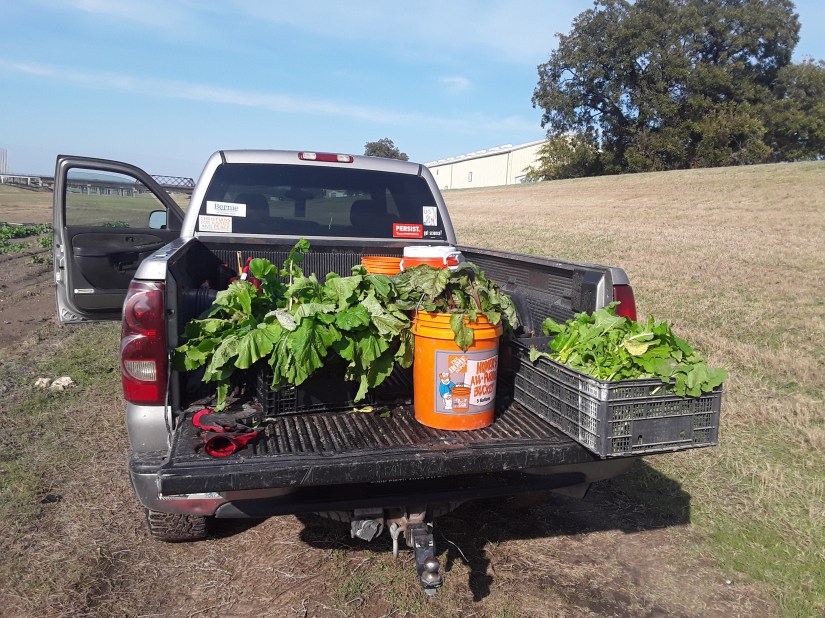
Most of you know that September brought record-breaking heat and only a trace of rain. We had to irrigate more than usual, and the carrots had to be replanted in October, but we still had radishes, turnips, greens, beets, and Butternut squash to take to market. Unfortunately, above average temperatures were followed by an unexpected early freeze. We are probably winding down our market stand for the rest of 2019.
Halfway through this weeks harvest
When we finally had some rain, it lasted for a few days. We
love rain though and, as for me, I had the first day off in three months! “Make
hay while the sun shines”, my Dad used to say so I did so. When the sun and
warm Fall weather returned, I looked at the spot on the Trinity River where we
set up our pump. I soon found out the negative consequences of the welcomed
rain…
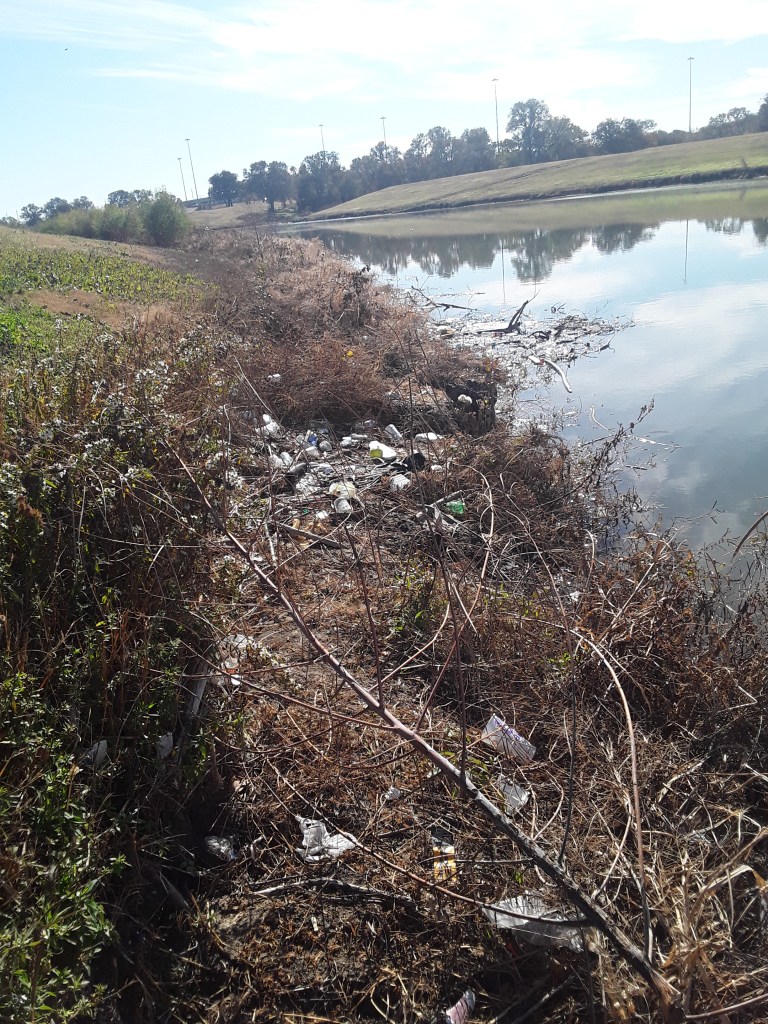
It was obvious that I had some cleaning up to do before I could use the pump again. You see, when it rained the river rose a bit. As it receded, all the trash that washed downstream came to rest on the banks of Opal’s Farm. Plastic bottles and straws, Styrofoam cups, and an odd assortment of empty chewing tobacco tins, single gloves and plain old litter were strewn about the bank and floating nearby. The place where our suction hose usually sits and where we get our water to prime the pump was thick with flotsam. Everything had to be scooped up before we could irrigate.
Just a portion of what washed down
I mention this not only because it causes a lot of work
better spent on the farm itself, but because everyone needs to know that litter
on our streets has a way of ending up in the Trinity. Storm drains and precipitation
runoff means that the plastic bags blowing down your street will likely end up
along our banks or worse yet, much farther downstream.
In October, we had the privilege of being an exhibitor at the Tarrant Regional Water District’s Trinity Trash Bash. Nearly 4,000 volunteers spent Saturday collecting over 28,000 pounds of trash. Let that one sink in – 28,000 pounds! Unfortunately, it’s only a fraction of the litter and illegal dumping that goes on all along the watershed.
I appreciate all the volunteers who take it on themselves to
address the debris in the river. It’s such a vital part of Fort Worth. Whether
it’s biking or running along the Trinity Trails, rowing or boating, or catching
a concert at Panther Island Pavilion the river is something we all enjoy. Here
at Opal’s Farm it’s part of our life blood, whether it’s for irrigation or just
taking a moment to enjoy a little bit of peace and beauty after a long day of
work.
Before you throw that candy wrapper down think about where
it ends up. Solving our litter problem is something everyone has a part in, not
just 4,000 volunteers on a Saturday. Who knows, if each of us took a moment to clean
up our little part of the world maybe those volunteers could spend their time
on other ways of making Fort Worth and the Trinity River a better place!
“Jesus wasn’t executed because he went around healing people; he was crucified as the worst kind of criminal because his Gospel message was viewed as dangerous by the ruling class. In fact, the entire Gospel of Luke is one long lesson in speaking truth to power—to the corrupt elite in Jerusalem. If we Christians claim to have anything to do with Jesus, then we must inherently be engaged with the political issues of our time.” – Peter Armstrong
Photo by Markus Spiske temporausch.com on Pexels.com



 gregoryjoel.com