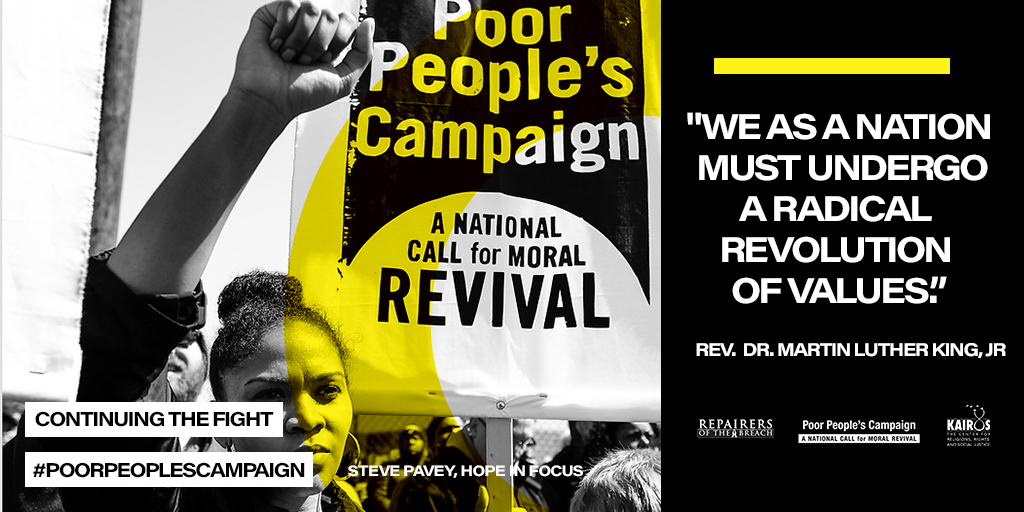
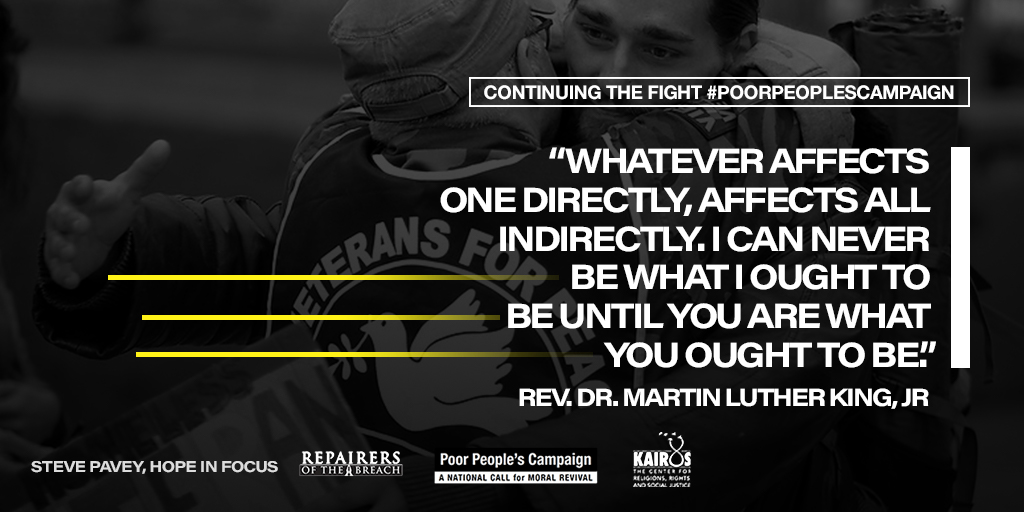
Martin Luther King, Jr. was assassinated on this day in 1968. Over fifty years later we still face the same issues he spoke and acted so passionately about. The time for a radical revolution of our morals and values has never been more needed.
#MLK taught us 50 yrs ago, what #COVID19 teaches us today: living wages, guaranteed health care for all, unemployment & labor rights are issues of right vs. wrong & life vs. death. #PoorPeoplesCampaign
Like most kids, I put a lot of energy into pushing the boundaries imposed by my parents. Being a people-pleaser by nature, I constantly sought ways to do what I wanted to do while keeping the appearance of being the good son. I was always looking for an “out”. I became so good at it that my mom would frequently suggest I become a lawyer when I grew up. After all, lawyers are experts at finding loopholes, at rationalizing behavior. Might as well get paid for it, right…
I’m not unique in this ability. It tends to be a common trait among human beings. Everyone looks for an out: a way to bend societal rules for their benefit, to make unacceptable, self-centered, or somewhat dubious behavior okay. Some are just better at it than others. I know. I have kids…
The whole process is about justification. The dictionary defines justification as “attempt to explain or justify (one’s own or another’s behavior or attitude) with logical, plausible reasons, even if these are not true or appropriate.” For example, I still smoke (cigarettes, not weed. I live in Texas, not Colorado). I am once again in the process of trying to quit. I know they’re bad for me. Everyone knows they’re unhealthy. It’s a nasty habit. They stink, they cost way too much, and constant smoke breaks up my productive time (I don’t smoke in my office so I have to go outside). Everything screams out “stop smoking”!
Knowing all these things I will still try to find my out; the loophole that cosigns my bulls**t. I remember reading an old Rolling Stone interview with John Lennon and Yoko Ono. They were into healthy living – good diet, exercise, good rest. The interviewer asked them why they still smoke if they’re so into health.
Their response always stuck with me – “We’re macrobiotic people”. What in heaven’s name does that mean?
The dictionary defines macrobiotic as “constituting, relating to, or following a diet of whole pure prepared foods that is based on Taoist principles of the balance of yin and yang.” Now I’m not judging, but what does that have to do with the unhealthy habit of smoking?
It’s a prime example of justification, of how we find an “out”. It may be plausible. It sure sounds good, but smoking is unhealthy no matter whether you’re macro or micro-biotic. I’m embarrassed to say that I’ve used this excuse (and a myriad of other justifications) on occasion . Hey, I gave up my other bad habits. I’ve got to have one vice, right?
The truth is that I’m unwilling to go through nicotine withdrawal. I’d rather justify my actions than quit. I can ask God to help me quit a multitude of times but, if I’m honest with myself (and you), I’m unwilling to do my part. Justification always tends to center around my unwillingness (or outright refusal) to change or dishonesty with myself.
What’s your “out”?
In Luke 10, a religious scholar comes to Jesus with a question (and questionable motives): what do I need to do to receive eternal life? Jesus responded in His oft-used way of answering a question with a question.
“What’s written in God’s Law? How do you interpret it?”
The religious scholar answered:
“That you love the Lord your God with all your passion and prayer and muscle and intelligence – and that you love your neighbor as well as you do yourself. ‘Good answer’ said Jesus. ‘Do it and you will live.’
Here it comes:
“Looking for a loophole, he asked, “And just how would you define neighbor?” (from Luke 10. 25-29 The Message Bible
Jesus goes on to tell the story we know as the “Good Samaritan” and the lesson of being a neighbor we usually focus on. Yet, the words “looking for a loophole” jumped out at me the most, because that’s what I do – look for a loophole, an “out” to get my way, a way to justify my actions. It’s been that way for a long time…
Loopholes, and those searching for them, seemed to frustrate Jesus the most. In Luke 11.42, Jesus tells all the religious bigwigs hanging around that:
“I’ve had it with you! You’re hopeless, you Pharisees! Frauds! You keep meticulous account books, tithing on every nickel and dime you get, but manage to find loopholes for getting around basic matters of justice and God’s love.”
The takeaway is that Jesus meant what He said – love God with all you’ve got and love other people like you love yourself. If we do this, everything else takes care of itself. We don’t have to look for loopholes (I still do anyway…). My actions speak much louder than my words.
Image credit Study for the Visitation Jacopo Pontormo
I want to be all in on this Jesus thing. I don’t want an “out”. I want to become better simply being me – to be a better husband, father, brother, friend, and to love and serve others, not just as I love myself (I still have days when I’m not so loving to Greg!), but as God loves His kids.
Being all in isn’t easy. Jesus takes “common sense” and turns it upside down. If you don’t believe me, have a look at the “Sermon on the Mount: Jesus’ manifesto for living. Things like ‘turning the other cheek’ and thinking of others more highly than one’s self run counter to everything in me. If I really believe Jesus meant what He said though, then I can stop looking for loopholes. After all, I didn’t see any “except when” or “buts” after His statements…
When I became a disciple, a student of “the Rabbi”, I slowly began to face the justifications that cluttered my life. Slowly but surely, they were eliminated one by one. Some I still cling to (like smoking) and try to justify their place in my life. Yet, the deeper I step in to the whole faith thing, the more difficult it becomes to hang onto them. It’s easier to find the willingness to escape them and see life as it really is.
Today I trust the process. Today I want to be all in. Maybe, just maybe, one more layer of justification will be peeled away and I come closer to the man I was always intended to be…
It’s a beautiful late winter morning here in North Texas. After a few days of rain and cold the sun slowly warms the day as it rises higher in the sky. There’s much to be done today and I’d love to take time to pass on deep spiritual thoughts from the porch but truthfully, such thoughts are elusive over the last few days. I struggle to write, to put thoughts to paper, and a cloud hangs over me even on a bright, sunny morning. I get frustrated, I pray, and try to listen, but it feels like God has put me on hold while He’s busy attending to other things…
My wife likes to remind me that there are times when no amount of spiritual awareness will take our pain or fear. My friend Jim used to say that “in the meantime, it’s a mean time”. There are times when God seems silent and I need to act as if He’s not. It’s the old “fake it ‘til you make” thing. I’m thinking I might be going through one of those times.
I don’t hesitate to tell of God’s unfailing love and grace in my life. Hindsight tells me that God has always, one hundred percent of the time, taken care of me (even when I was far from Him doing my own, self-destructive thing). Unfortunately, the lens through which I look forward can be awfully opaque at times (we walk by faith, not by sight, right?). I speak the truth when I share about God’s provision and care, but I’m surprised at how quickly I forget that when life feels overwhelming.
Margaret and I are going through some difficult financial times right now. Almost two years ago, I made a commitment to the mission of Opal’s Farm and made it my full-time endeavor. We knew this would be difficult because we’re dependent on donations for my salary. Unfortunately, winter is a slow time for both the growing season and for contributions to our non-profit. Although Spring brings a wealth of opportunity for market sales and donations that doesn’t pay this month’s bills.
I mention this is not to whine about it – we took this on after prayerful consideration and eyes wide open – but to say that finances are one of the toughest areas in my life to turn over to God. Margaret is far better able to do that than I am. It may be because as a man, I sometimes feel I’m not doing my part to take care of my family. To Margaret’s credit, she’s my biggest cheerleader and reminds me I’m on the right path.
I begin to doubt I’m where God would have me be and think I should throw up and hands and go find something else. The little committee inside my head begins to tell me how foolish I am. Negative self-talk and doubt of God’s blessing fill my days. Honestly, I feel like a hypocrite at times. I’ll tell everyone of God’s faithfulness while my mind tells me I’m a fraud, that God isn’t really taking care of me.
That being said…
You might notice that the word feel is in italics. There’s a reason for that. You see, it took me years to learn to separate my feelings from my reality. That lesson may have come much easier for others, but it was a long, painful, and often frustrating journey for me. When I began to see what was going on around me for what it is rather than what it feels like it is, I began to understand that doubt was an essential part of my faith journey.
That may sound a bit oxymoronic – doubt and faith are mutually exclusive terms, right. Still, it’s possible to doubt and still be faithful. It’s a painful process to walk in faith through doubt and darkness. We can’t see in the darkness. St. John of the Cross, a 16th century Spanish mystic and Carmelite priest, called this “the dark night of the soul”.
The journey through the darkness leads us to shed all our preconceptions about God. We begin to let go of our ego, our perception of our self, and rest in “unknowing”: the unfathomable spirit of God. The journey can be long or short. For me, it’s often been a case of “two steps forward, three steps back”. In the darkness I find my union with the Father deeper each time. My petty worries and struggles seem a tad easier. Trust begins to return. I just keep walking…
St. John of the Cross
Sharing the journey, the struggles, the fear, and “the dark night of the soul” is frowned upon in many churches. We don’t like to talk about it. We write off what we fear or don’t understand so it won’t “wash off” on us. It’s dangerous to around a “doubter”.
Honest lament is frequently met by simple answers and platitudes. Things like “we’re praying for you” just have faith”, don’t doubt God’s promises” – that do little to illuminate the path.
Some give up, retreating to the relative safety of sameness. Others throw up their hands, utter “what’s the use?” and leave behind the very community that God created for us. I don’t think that’s what Abba intended…
A Few Days Later…
I began writing this last Saturday. Yesterday was a great day at the farm – a special visit by Mailik Yakini from the Detroit Food Policy Council, getting to spend time with other local farmers, and getting a lot of planting done. The financial worries slipped away, replaced with feelings of fellowship and connectedness. At the end of the gathering, Ms. Opal pulled me aside. She whispered, “the Lord is so good, and He’s provided again. We received a check from a donor and there’s a check for you at the office.”
We’re able to pay all our bills for this month. One more time, like countless other times before, Abba has provided for all our needs. I used to beat myself up for doubting God. Today my doubts are merely one more opportunity to demonstrate God’s goodness and care. Hindsight reveals even my darkest periods, those which God felt so absent, have been the greatest blessings in my life.
What I thought was bad turned out good. What I thought was good wasn’t always so great (if you know what I mean). It reminds me that I don’t know what’s best for me, but Abba does.
We will encounter difficulties once again (especially financial ones) and I’ll begin to question God about His sense of timing. I’ll have some fear, but it seems to be a little less each time life shows up. God’s promises always hold true, even when my faith wavers so I’m just not going to worry about the process anymore. In the darkness I discovered a light that never goes out. I don’t always see it, but my vision is becoming clear with each step in the journey.
Like many people, I probably fall into the “spiritual, not religious” polling category these days. I still claim membership to a large non-denominational church that used to wear the name “Church of Christ”, but I rarely attend anymore. Even though there are many things I love about my faith tradition, I find myself uncomfortable in a place where “white, suburban, middle-class” continues to be the dominant member demographic.
To be fair, my church tries to be inclusive and has always been welcoming of everyone. They serve both the local and global community. It’s just that for the most part, most of the congregants are white. That’s what happens when you’re located in a predominantly white suburb. It’s the whole “birds of a feather” thing. It’s not intentional, or is it?
The issue of race and racism in my church began to rise to the surface last year. Although it saddens me that it took so long to come up, the minister took a bold leap and preached a series on race. For most of those of the Caucasian persuasion this meant having to discuss racism and race, particularly in the church, for the first time. I applaud their efforts. Quite frankly, white people are extremely uncomfortable talking about such subjects. They deny the problem like an alcoholic denies their alcoholism. It requires a level of honest appraisal that most folks shy away from. Ripping off the intellectual bandages to reveal an ugly, festering wound is painful, but necessary to heal properly. That’s why I was excited to see them offer a seminar “Let’s Start Talking About Race”. At least they’re talking, right?
“In Christ’s family there can be no division into Jew and non-Jew, slave and free, male and female. Among us you are all equal. that is, we are all in a common relationship with Christ. Also, since you are Christ’s family, then you are Abraham’s ‘descendant’, heirs according to the covenant promises”. Galatians 3.28-29 – The Message
My biggest fear is that my church will stop at ‘talking’ about the problem. My friend, Jim, always told me that “when all was said and done, more would be said than done”. Like the alcoholic who sees the reality of their alcoholism, the church is left with a choice: either continue the destructive behavior or take an active part in the healing process. Action is often simple, but far from easy. Honestly, most of us choose an easier way. That’s scary and a bit hopeless. The good news is we don’t have to do it alone.
I don’t pretend to have the answers. I know however, that relationships are the key, especially ones with people of color. Several years ago, I was working for a local ministry on a community garden on the heart of Como, a predominantly African American and neglected, low income community here in Fort Worth.
During the first days of tilling, building beds, and planting, a guy who rode his bike past the garden each day, stopped and asked why we were tearing up the vacant lot where old downtown Como used to be. I explained to him what we were doing – building a garden that would serve the community. His response was unexpected.
“You white folks come down here and tell us what’s good for our neighborhood as if you know better than us. Your white church comes down here for a few days to help us poor black folk so you can feel better about yourselves and tell everyone to look and see what you did. Then you go back to your nice comfy suburbs and leave us to clean up the mess”.
I thought for a moment, looked him in the eye, and said, “You’re right, but I’m not going anywhere. I’ll be here tomorrow and the day after that.” He grunted and rode off down the street.
What the gentleman passing by didn’t know was that I was working for a neighborhood ministry. Still, I learned something that day. Good intentions hide the fact that we’re still a part of the systemic racism that plagues our society. We don’t listen to communities of color because we think we know better. We think know better because of our implicit bias that says the dominant white culture is ‘normal’ so it must be right. What is that but white supremacy. Ouch…
Several days later, the same guy began to say hello as he rode past each morning. This continued for a few mornings until one day he stopped to ask what “that was coming up over there?” We began a conversation and he introduced himself as Stephen. I introduced myself and we talked about what else was coming up. A couple of days after that his stops became more frequent.
He spoke of the rich history of the land I’d planted, how the neighborhood movie house had been there and how the old downtown had been a vibrant gathering place for the community. He began to stop regularly and chat, asking how things were going. His initial combative attitude changed to one of neighborliness.
The lesson I learned from all of this is that we begin to see each other differently when we spend time with each other. People cease to be ‘them’ and divisions begin to break down. That’s hard to do in a place, especially a church, that lacks diversity – diversity of thought, color, and culture. Unfortunately, Dr. King was right – “It is appalling that the most segregated hour of Christian America is eleven o’clock on Sunday morning.” That lesson has been reinforced many times over the years. I’ve had to take a long, hard, honest look at myself in the process.
I’ve had to identify the old tapes and the old ways of thinking I grew up with. I had to be honest enough to admit my shortcomings and ask God to remove them. I had to repent, or rethink, my old ideas and actions.
I love the word repent. Acknowledging the problem is the first step to a solution, whether it be in spiritual or worldly matters. Jim always told me that once I identify the problem I’m halfway to the solution. Repentance is full of hope and possibility – for all of us.
As I have said, I don’t know all the answers and I’m certainly no expert on racial issues However, I know everything has a beginning. Honest conversation (and listening is the key to conversation) is a great place to start. Just don’t stop there and start walking…
Image credit The Angelus (detail), Jean-François Millet, 18571859, Musee d’Orsay, Paris, France.