What a week at Opal’s Farm! We have everything in for fall and winter and have started taking out spring leftovers, rebuilding beds, and solarizing them for weed control in the spring. We finally took out our tomato plants, but not before harvesting about a hundred and fifty pounds of tomatoes – and it’s ten days until Christmas. We love that a hard freeze hasn’t come yet, but we’re also a bit worried as this is another indicator of how strange our weather has become.
The weather is a “frienemy” for farmers – it brings the rain that helps the crops grow or the drought that kills them off. It’s the one thing we can’t control. We may do a rain dance or pray a freeze holds off until the crops come in, but in the end, the weather does what it will.
However, even weather has things it can’t control either – a warming climate changes the weather – leading to warmer average temperatures and more intense weather events. The intensity of our North Texas summer over the last two years is an example. In 2022, the heat came early, and the rain stopped. There was no rain from June 3rd until August 29th. It was much the same this year with 2023 being the second hottest year on record according to the Texas Tribune and NOAA. Moreover, when it finally did rain, it rained so much and so heavily that Opal’s Farm suffered flash floods both years.
Hardiness Zones – the zones which show the lowest temperature in a zone and determine the growing season – have gradually moved northward. According to Yale Environment 360, hardiness zones were moved northward from 1990 to 2012 and are moving at a rate of just over thirteen miles per year. The heat is headed northward. Fort Worth has shifted from Zone 8b to Zone 8a. What and how much we grow changes as the zones move north.
So, What Do We Do?
Opal’s farms about two-and-a-third acres at present. We are growing into the full five acres granted to us by the Tarrant Regional Water District. We don’t expect to see major changes, the amount of land is negligible in the grand scheme of things. However, there is something we can do that’s consistent with our core values of resilience and regeneration.
First, we can continue to research and try non-native (but non-invasive) varieties of food crops that are both heat tolerant and drought resistant. Our salad mix uses Tokyo Bekana along with other Asian greens. Tokyo Bekana looks and tastes like lettuce (some say even better) but it’s actually related to Chinese cabbage. It fares much better than traditional lettuces that can only be grown in early Spring or late Fall. It can be grown year-round in North Texas.
We use this same practice on other crops as well. We are slowly beginning to turn to south Asian foods like bitter melon, bottle gourds, and yard-long beans. The beans are quite prolific and love the summer heat.
Secondly, we never leave exposed soil. Cover cropping is essential. Always have living roots. We are finishing up cover cropping all all non-food crop beds. We use Austrian Winter Peas and Elbon Rye in the winter time. Legumes like the peas fix nitrogen into the soil and the rye’s root system keep the soil broken up and able to retain water and oxygen better for the soil microbes. We use various mixes that we purchase from Green Cover Seed in the warmer months.
Finally, we sequester carbon in the soil. Our biointensive beds are no-till while the remainder of the farm is minimal till. Dr. Omar Harvey, with the Geosciences Department at Texas Christian University, had students researching carbon sequestration at Opal’s Farm beginning two years ago. The explanation of the methods used is several pages long, so I’ll not bore you with the process, but the results are important. Dr. Harvey’s students were able to quantify the carbon sequestered away on the farm and found it to be 168 metric tons per acre.
Why is that important?
It’s important for two reasons. One, the research confirmed not only the amount but the type of carbon – deep carbon. When the carbon is sequestered deep in the soil it stays there and is less likely to be released into the atmosphere. The carbon sequestered in the upper eight inches of soil is still available for the plants which is a winner for both the climate and us.
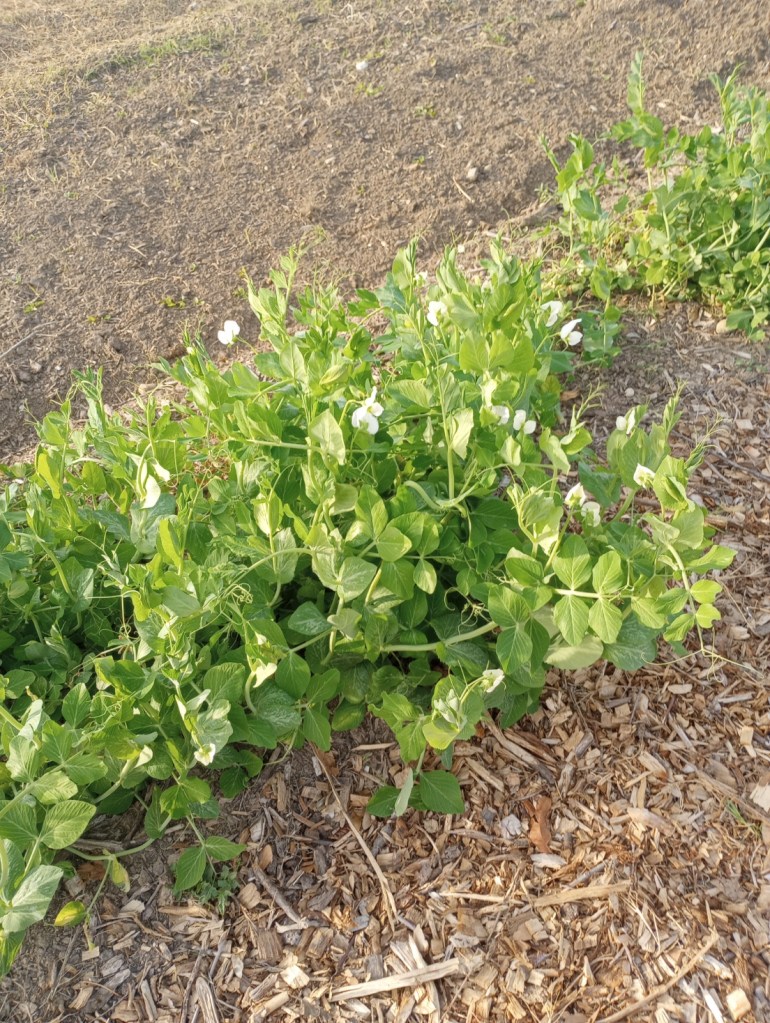
Our Sugar Snap Peas are blooming and will be available shortly!
I have mixed emotions about the second, and most economically beneficial, reason – that being the figure for carbon credits. At four to five dollars per metric ton Opal’s could generate anywhere from nine to eleven hundred dollars per year in extra revenue. Alternative revenue streams are a must for small farmers.
However, the alternative here seems to be a bit of greenwashing. The idea that a company such as an airline can use carbon credits to meet their climate “goals” while continuing business as usual is somewhat opaque in nature. The bottom line however is that carbon is sequestered and can offset the gases released into the atmosphere. The more regenerative agriculture practiced, the more carbon stored away and an alternative income stream for farmers doing what they do naturally.
Whether for the economic benefits or for the common good, regenerative agriculture can play a large part in facing the climate crisis. Next Spring, we are attending classes to become Carbon Farm Planners. Agriculture can be part of the solution and the more we know the more equipped we are for positive change.
We may not be able to change the weather, but we can do our part to adapt and bring healthy, nutritious produce to Fort Worth and fight climate change in our little piece of Texas. As Ms. Opal often reminds me, “Be a committee of One”. I remember Dad telling me that “everybody complains about the weather, but nobody does anything about it”. Being a Committee of One, one small urban farm, is doing something about it. Join us in the fight. As Mother Teresa said, “If you can’t feed a hundred people then just feed one”…

 gregoryjoel.com