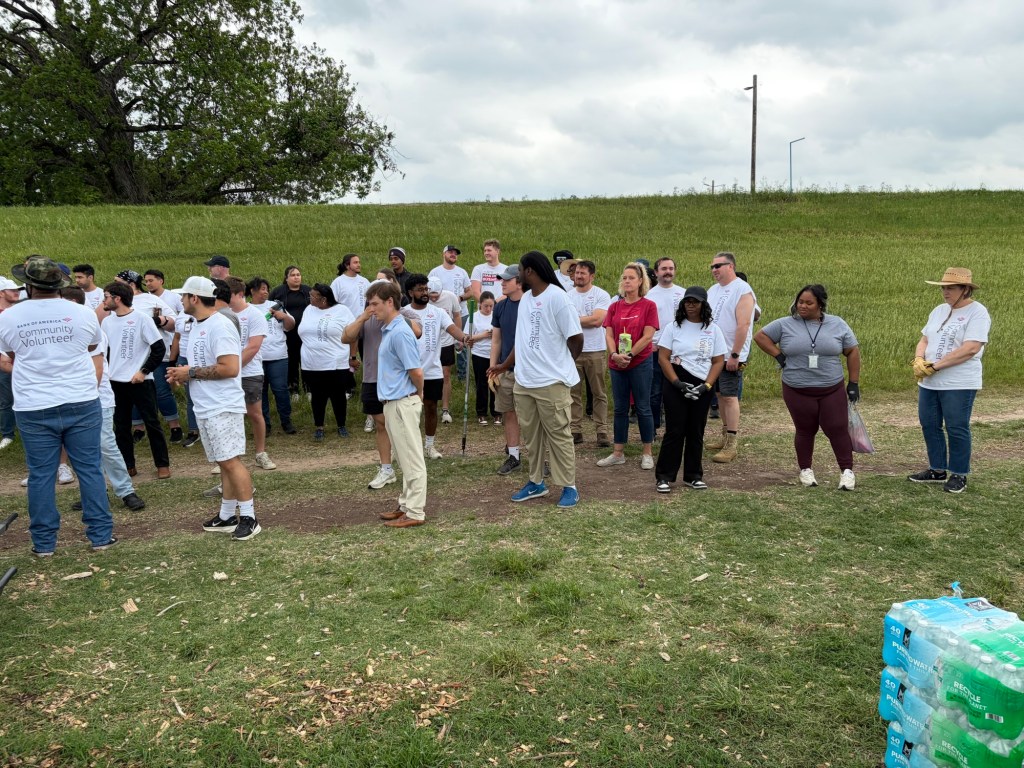
Good Sunday morning to all from Opal’s Farm! It’s been a great week at the farm. Volunteers (almost a hundred of them) came from Bank of America on Friday, and I’m simply amazed at the job they did. The farm looks great! Beds are prepped for more Spring planting this coming week, tomatoes are trellised, compost and mulch laid down, and you won’t believe the pile of weeds that were pulled. Thank you to Margo, Eric, and Aaron for getting their respective teams for putting this day all together. Thank you so much to Bank of America. They’ve been such a good friend of Opal’s Farm and the National Juneteenth Museum as well.
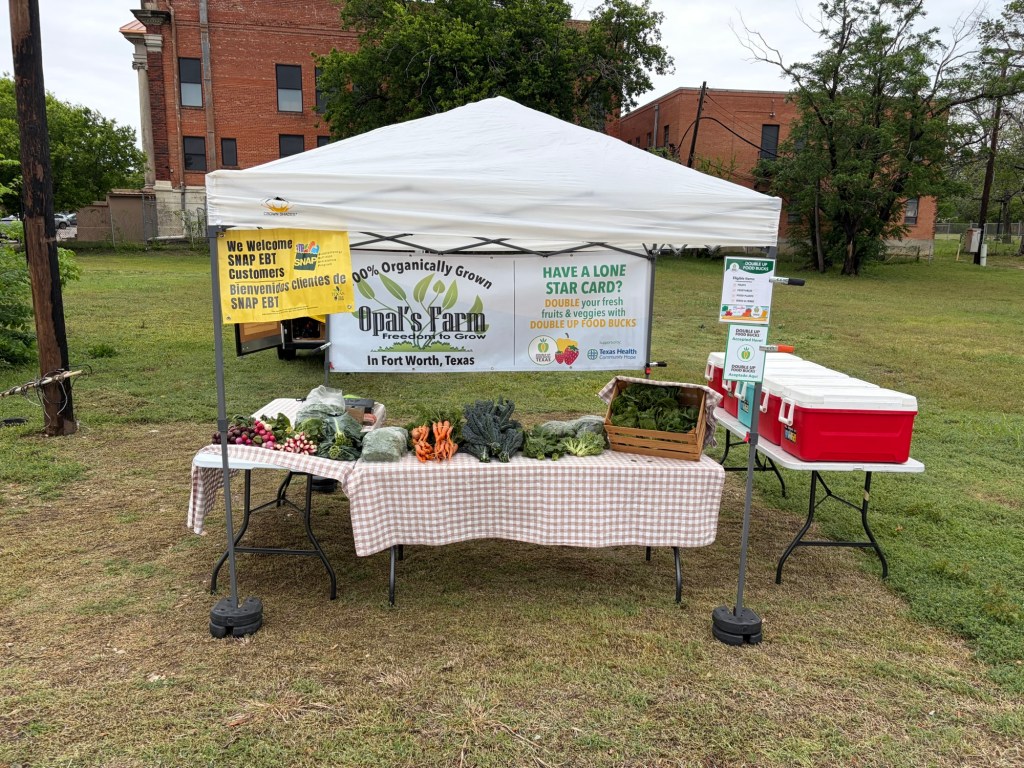
We didn’t have Opal’s Farm Stand yesterday due to the much-needed rain we had yesterday. However, the farm stand will be open today from 1PM to 4PM at the corner of Rosedale and Evans. We have a good selection of produce this week with even more coming as Spring moves forward. We hope to see you all there.
Farming has its challenges. The weather is either too wet or too dry, too hot or too cold; equipment breaks down at the most inopportune time; pest pressure; the list goes on. The latest challenge – water level on the Trinity River, which provides water for irrigating our crops, dropping lower than our pumps can reach, leaving us high and dry with new Spring seed in the ground. The Tarrant Regional Water District has construction going on by the Fourth Street dam just upstream from us and had to lower the water level in our section of the river to complete the work. It may be a month before the water level returns to a normal level. The farm can’t go for a month without water, and the weather forecast isn’t looking favorably for us. “Houston, we have a problem…”
The immediate issue was getting water on the new seed as quickly as possible. To make a long story short, it was too muddy to get our other pump close enough to the water to get to suction hose in, so I filled four fifty-gallon water barrels at home each morning, drove to the farm, and hand watered the new seed, all the while praying to seek a better solution. The process was long, slow, and really hard work for this old man.
I trust that God hears my prayers and always answers even though I don’t always listen very well (and if I’m honest, I’ll still try to figure out things my way because I don’t like the answer, but that’s another story). Still, I’ve gotten better as I’ve gotten older at watching and listening for God’s instructions.
This week, the answer came from one of our regular volunteers and friends of the farm, Amir (I haven’t asked his permission to use his full name and picture on social media yet). Amir is one of my favorite people. He comes most Thursdays and Saturday mornings to help at the farm and often brings his young son as well. He believes his son needs to learn the value of helping others (that won him Father of the Year in my book). When he saw our problem, he called to meet me at Opal’s Farm on Friday morning. He wanted to put our heads together to see if we could find a solution to the irrigation problem.
We pondered our options and then it occurred to Amir that we could pull the pump from its pipe to the river, extend the Pex piping and electrical wire and push the pump farther into the river. Great idea! I was fully expecting Amir to have to go on to his work and do it over the weekend. He looked at me and said, “If we can get the parts this morning, we should have water this afternoon”. Needless to say, after a very long Friday and very cold Trinity River water we have irrigation again.
The reason I mention this is because I need to tell you how blessed I am to have great volunteers, and especially Amir. He sees his time as an investment in Opal’s Farm, our mission, and our future. He gave up his work time to help at a critical moment. That’s the kind of people that God has blessed me with over the last seven years at Opal’s Farm. I just want to give him a special shout-out.
Texas Farm Bureau Day
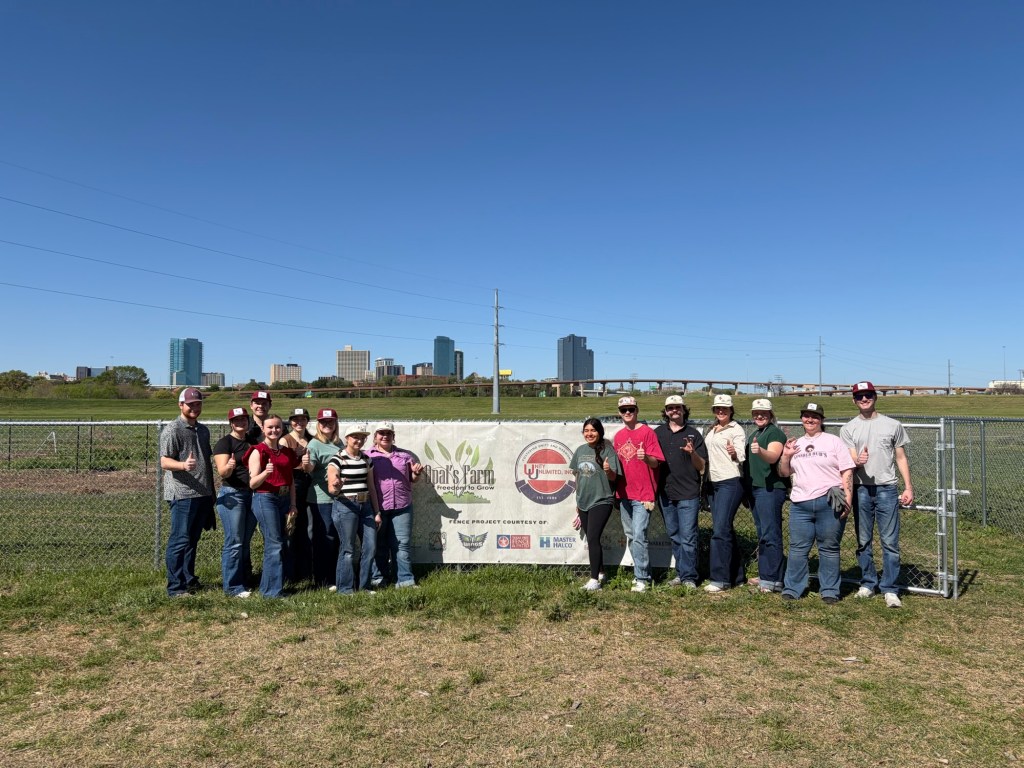
We were also blessed to have a group of college students from around the state and the Texas Farm Bureau come by on Saturday morning. Many of these folks have production farming experience so the amount of work and the initiative they brought to Opal’s on a Saturday morning was beyond amazing. Thanks to these young people our tomatoes are planted, most of the trellises up, and the beds are weed-free (at least until the next rain…). Thanks to Kyndal with the Texas Farm Bureau for putting all this together!
If you would like to volunteer as an individual or as a group, please feel free to call 817.602.8225, but hurry as Spring dates are going fast.
Winter will be making its last gasp (hopefully!) later today here in North Texas. We go from a high temperature of eighty degrees to a Monday high in the fifties with a frost warning for the morning. Weather in North Texas, particularly this year, can be diagnosed with severe bi-polar disorder. We go from extreme highs to extreme lows in a flash. It’ll be ninety degrees by Thursday. It looks like our tomatoes and peppers will be covering my kitchen floor tonight…
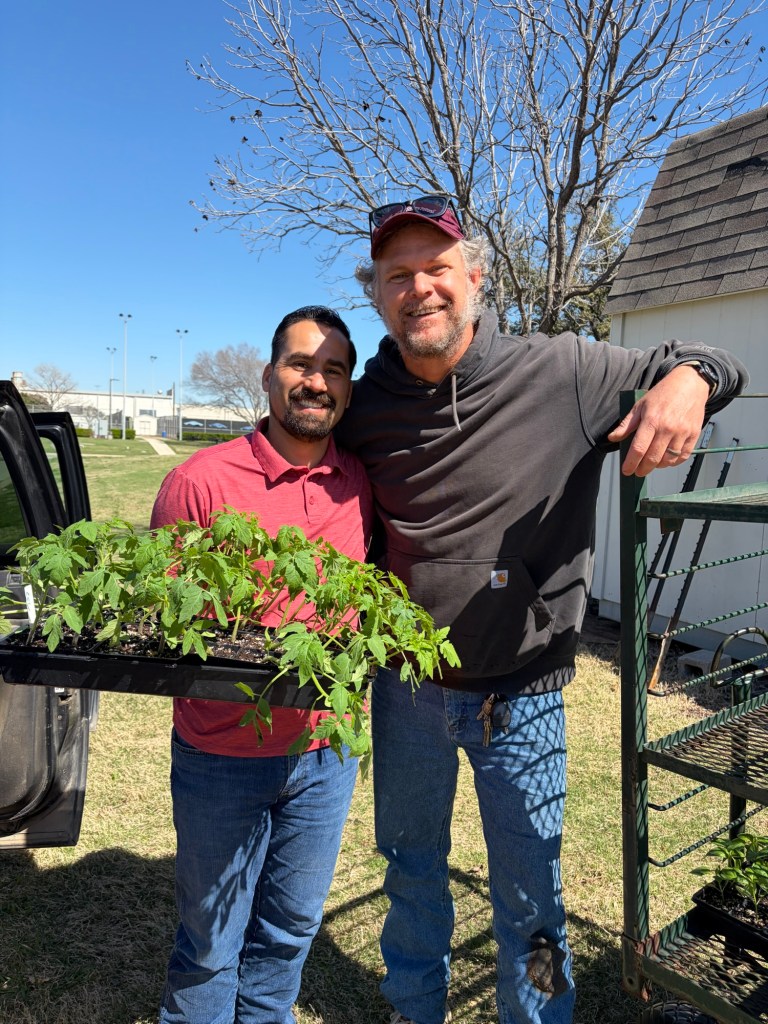
I picked up our transplants of tomatoes and peppers on Thursday. Tarrant County College’s Northwest Campus Horticulture students grew our starts again this year as they have for the past five years. I’ve been so grateful to have such a wonderful partner for the farm at TCC. Instructor David Cole has not only grown our starts every year, but he’s also brought his Food Crops class to Opal’s for a workday and tour each semester. We love having them out and the ongoing volunteer relationships that develop.
Steven and David
This year we had an additional treat as Steven Nunez, of Mind You Garden Urban Farm and Grow SE, joined TCC as head of the Horticulture. Steven and his wife Ursala have been a vital part of Grow and done amazing work with Mind Your Garden – a homestead farm in southeast Fort Worth.
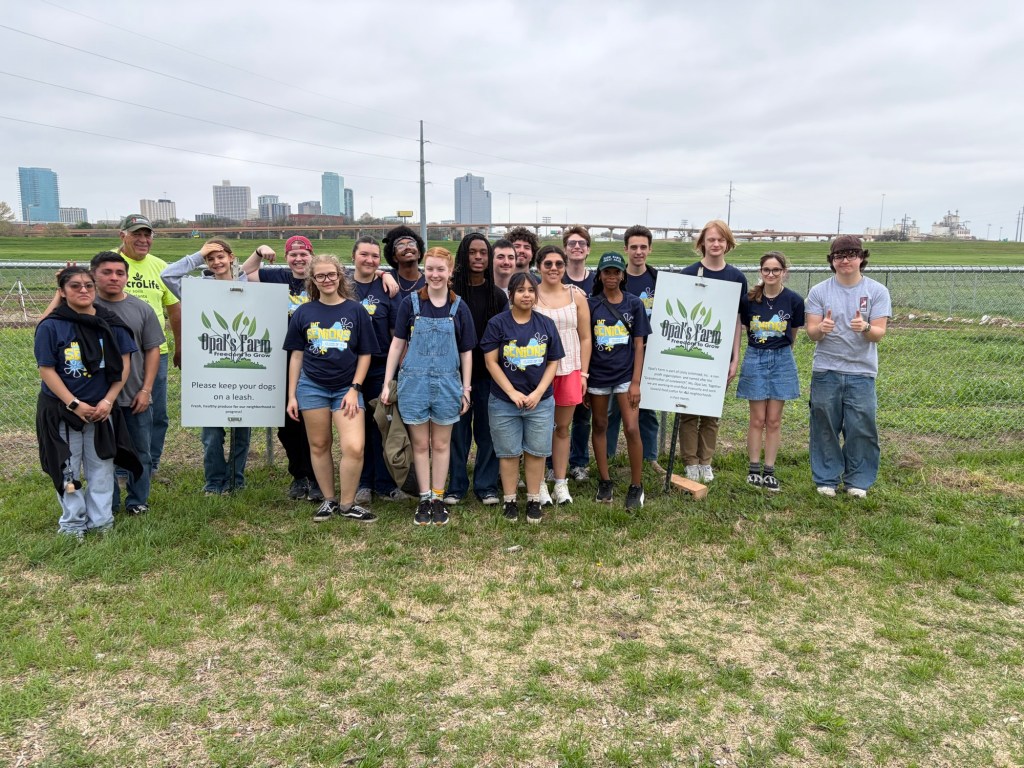
I also had the privilege of hosting some of the IM Terrell Academy seniors for a volunteer day this past week. It’s always such a pleasure to see young people working hard and enjoying a day at the farm. They were a tremendous help and accomplished more than I could have imagined in their morning with at Opal’s Farm.
IM Terrell Academy Seniors
I also had to reschedule our Grand Opening for Opal’s Farm Stand to April 4th (the first Saturday) and make some changes to the proposed days. We will be at 1115 Evans (Evans and Rosedale) every Saturday from 1 PM to 4 PM. We’ll still be taking some produce to the Funkytown Mindful Market, and they will have our produce available for sale as well. We are so excited to be serving our Historic Southside neighbors.
Y’all stay warm tonight and have sweet dreams of fresh Spring veggies!
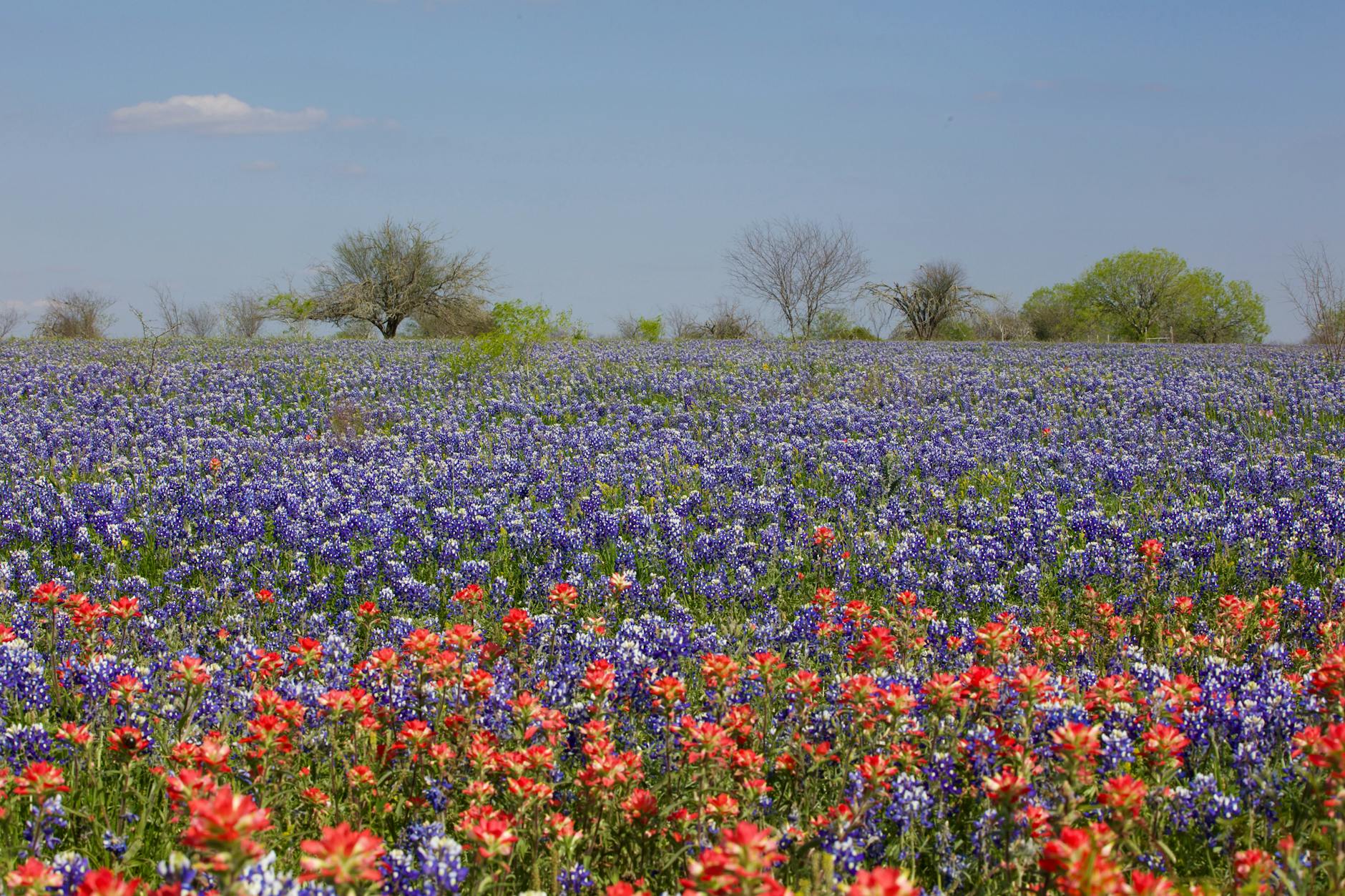
I was driving home on I-30 from the farm last Tuesday. Tiny spots of blue caught my attention as I sat in the rush-hour traffic. They were the first Bluebonnets I’ve seen this year. The frustration from the slow-moving traffic vanished; replaced by a sudden desire to pull off to the side of the interstate and take a picture.
Bluebonnets are the state flower of Texas and rightly so. They announce that Spring is finally here and will soon blanket the side of roadways and highways in a carpet of blue. The other wildflowers – Indian Paintbrush, Winecup, Mexican Hat, Indian Blanket, Evening Primrose, etc. – will soon paint the roadsides of the highways and country roads in vibrant reds, oranges, yellows, and of course, blues. Bluebonnets always lay the foundation for nature’s paintbrush.
Families will soon be pulling off the road to take pictures of the family amidst the field of color. This is a annual Texas tradition. I often wonder if photographers consider this one of their busy seasons. The only sad part is that family photographs often leave matted-down holes in the blue-hued fields.
I really needed the Bluebonnets this year. The experts at the Ladybird Johnson Wildflower Center predicted a mixed wildflower season this year because of the drought facing West Texas. Winter was relatively mild. Even a muted wildflower season reminds me why resilience is one of our core values at Opal’s Farm.
The craziness and in both Austin (our state legislature is in session) and Washington D.C. makes for an uncertain future for many non-profits like ours and small farmers everywhere. I’ve had to take a break from the news lately except for local news stations and that’s mostly for the weather reports. It doesn’t mean that I plan to bury my head in the sand. It simply means there is more time to see the Bluebonnets, to enjoy Spring, and get lots of food out to folks. Opal’s Farm, like the Bluebonnets, will keep growing food, loving people, and building community.
I apologize for not posting regularly over the last couple of months. Opal’s Farm is going through several changes right now – most notably in staff. Recent cuts to USDA funding and January resignations have left the farm work to myself, my Volunteer Coordinator, Stacey Harwood, and a small number of volunteers. We are still on track for all our Spring planting and looking forward to a great harvest.
The bipolar Texas weather hasn’t helped even though it has kept things interesting. The freezing weather one week and in the eighties the next caused some of the winter crops to bolt. That was followed by seventy-two hours of sub-freezing weather and the plants took it much harder than the first round of freezes. The good news is that it looks like we’ve had our last hard freeze. Tomatoes are coming on the 17th and the rest of Spring planting is underway. We’re looking forward to bringing the Spring harvest to market!
I would also like to take a moment to talk about the many non-profit organizations working in agriculture and food systems. They have endured financial hardships due to the recent changes at the USDA. Some programs that aid farmers and farm organizations have been shut down indefinitely as funding has been frozen or eliminated entirely. Economic uncertainty faces us all.
The average age of a farmer in Texas is sixty-two. Part of our mission is to incubate new farms and train new farmers. American Farmland Trust has a slogan that says it all: “No farms. No food”. Please consider the importance of our local farmers, the healthy fresh produce they bring to our community, and the education they bring to the next generation of farmers, both urban and rural.
I’ve spent the last two months with our “Taste the C.U.R.E.” students and seen the interest and willingness to be part of the grower’s community. Not only do they want healthy food for themselves, but they want to feed their neighbors. Urban agriculture is a growing alternative to high food prices and the ultra-processed food found at the big grocery stores. We hope the movement continues to grow and that you can become a part of it.
You can support your local farmers and food system through financial donations, calling your elected representatives, volunteering at a local farm, or simply shopping local at your local farmers market or farm stand. Not only is local produce healthier, it ensures that food access is available to your community. Food access is not a “DEI” issue. It should be available to all of us. Healthy food is a basic human right. Your local farmers are working long hours to feed us all. Buy local and support your local farm!