Communication, Community, Down On the Farm, Faith, Fall, Food Equality, Food Insecurity, Food Justice, Gifts, Goodness, Grace, Gratitude, Hope, Neighbors, New Year's Day, Non-Profits, Opal's Farm, Regeneration, Role Models, Service Organizations, Service to Others, Social Justice, Spring, Stories, Thoughts From the Porch, Unity Unlimited, Inc., Urban Farming

Yes, It’s Another Best of List…

My inbox has been filled with “Best of 2023” lists from the various writers and organizations I follow. As 2023 winds down I find myself thinking about all the wonderful things that have happened at Opal’s Farm and the ups and downs of the past year I’ve encountered personally. So, with that in mind I present to you the Best of 2023 for Opal’s Farm.

Ms. Opal

The biggest happening at the farm is always Ms. Opal herself. Each passing year reminds me of the blessing of her presence. Her love for others, her stamina and exhortations to become a “committee of one”, and her tireless work for our community revitalize us daily to make the farm the place to come for food, education, and the promise of food justice. She constantly reminds us that the walk toward equality and justice is one step and often with one person at a time. Our energy is always revitalized by her leadership.

Tomorrow my wife and I will celebrate New Year’s Day the way we have since I started at Opal’s Farm. At two in the afternoon, we’ll be present for her New Year’s Day dinner – along with a couple of hundred others! When we received the RSVP invitation it listed her accomplishments in 2023 so I’ll share them here:

  • Texas Senate portrait reveal – hers is only the second woman’s portrait to hang in the Texas Senate Chamber. The other is Congresswoman Barbara Jordan.
  • Three honorary doctorates
  • Two events with Cynt Marshall of the Dallas Mavericks
  • Several assemblies at schools with young people
  • Conversation with Brian Stevenson for the National Juneteenth Museum
  • Several visits to the White House 
  • Visit with the Governor to talk about the National Juneteenth Museum
  • Reveal of portrait for the National Art Gallery
  • Inducted into the Texas Women’s Hall of Fame
  • Received two EMMY Awards – both the Governor’s Award and the Award for best documentary

New Awareness

Ms. Opal also visited the USDA People’s Garden in Washington DC and was featured in a national article for the USDA Natural Resource Conservation Service (NRCS). Both our Executive Director, Dione Sims, and I were invited to a roundtable discussion with Congressman Marc Veasy and US Department of Agriculture, Xochitl Torres Small along with a small group of local non-profits and City Council members.

The USDA is beginning to take a serious look at both local and urban farms and our food system. They opened their Urban Farm office in Dallas this year – one of ten cities to have one. Opal’s is by no means the only urban farm in Fort Worth, but we have had the privilege of hosting the NRCS staff for our area several times as they learn and extend their work to urban agriculture.

NRCS engineers have given us new plans and specifications for better irrigation at the farm. We are changing our irrigation over the winter months so we can grow more food for our community.

New and Old People

The Spring growing season was a time of transition for Opal’s Farm. Our previous Assistant Farm Manager, Amber Carr, helped build the infrastructure for our bio-intensive third-of-an-acre. She left the farm in July, and we were blessed to have Joseph (Joey) Hughes step in this Fall to take over our bio-intensive section. Joey came to us from World Hunger Relief in Waco and has an extensive background in education and urban agriculture. We’ve extended our programs to include agrotourism and educational programs for the community. We’ve also partnered with Delve Experience to a make tours and education more accessible through their website https://delveexperiences.com/ .

We’ve continued to build our partnership with Tarleton State University. In the coming year two new programs for both the community and previously incarcerated individuals will begin. We are presently finishing the curriculum and the final details. We’re excited to share this with you as 2024 begins (more to come!).

On Friday, December 22nd, we held our first-ever farmstand at the corner of Sylvania and LaSalle near the entrance to the farm. We are now able to support a regular farmstand on a weekly basis for the United Riverside neighborhood of which we are proud to be a part of (you don’t have to be a neighbor to come!). We are presently open from 10 AM to 2 PM but this might change as we get more input from our neighbors.
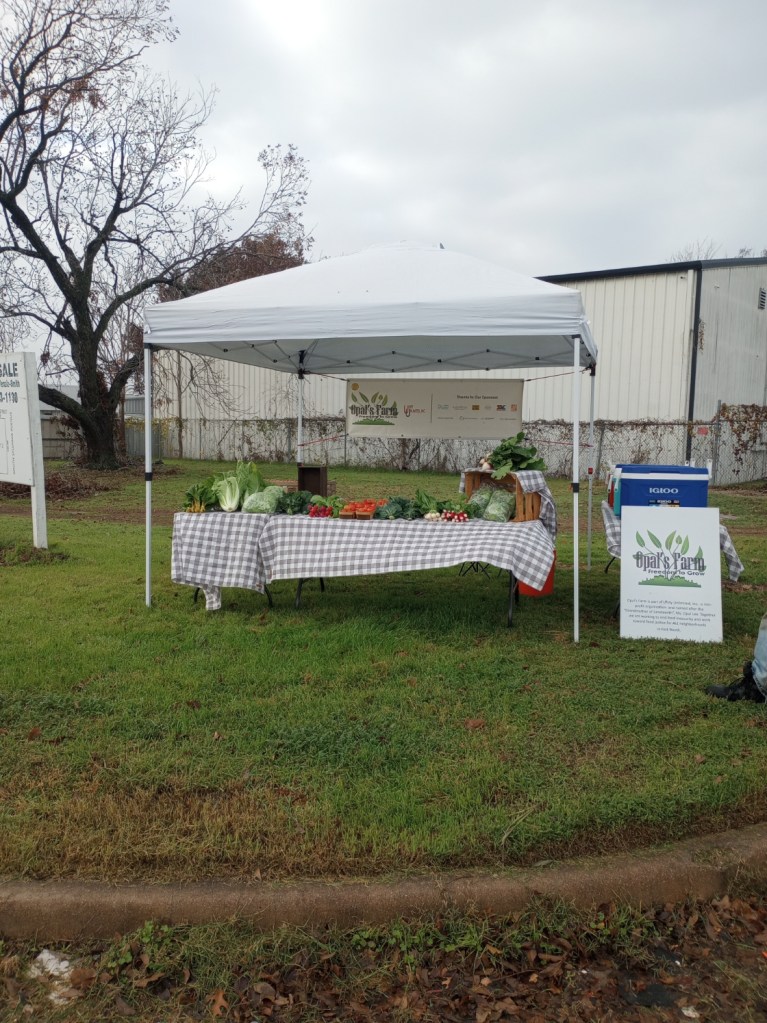
We’ve long hoped to be able to have our own farm stand and the final incentive came in November when we became authorized to accept SNAP benefits. This has been a game-changer for meeting our community goals. Please feel free to come by and check us out. You can tour Opal’s Farm while you’re there.

We’ve had some awesome volunteers this year and particularly this Fall. Stacey Harwood returned from medical leave as our Volunteer Coordinator in September and has done an amazing job getting some big projects done. We’ve had more time this Fall to plant more hundred-foot beds and expand our biointensive beds. We could not have done it without our volunteers and Stacey’s help. We want you to know how treasured and appreciate our volunteers are. You make the farm complete!

There have been so many things that have made 2023 a successful and major growth year at the farm. I have no doubt I’ve left some significant moments out. What I can tell you is that donors really stepped up this year to make 2023 and the coming year special. We’d like to thank the Enterprise Foundation with Enterprise Car Rental and the Stewart Family Foundation for the special awards that will keep Opal’s Farm expanding through 2024. We’d also like to thank KPMG Inc. and JP Morgan Chase for their continued support!

I cannot finish the “Best of” list without a thanks to our Executive Director, Dione Sims. We are a program of Unity Unlimited, Inc. and Unity’s support and belief in Opal’s Farm is what drives us. Dione spends many hours with all the various programs Unity does throughout the year, but she always has time for the farm. Thank you, Dione, for being an awesome leader, a friend, and a mentor!

On a personal note…

This past year has been incredibly hectic. It’s often difficult to “stop and smell the roses”. I, for one, have learned the value of tasking time to count God’s blessings. I am one of the most fortunate people I know. I get to go play in the dirt – to do what I truly love and am passionate about – and I get to do it every day.

Any kind of farming, whether it be urban or rural, is hard, but rewarding work. On the 110 degree days in August I ask the same question – why do I do this stuff? Then, I go to the markets we attend, and I get to see and know the people we serve. You all have made the year wonderful.

I hope and pray that 2024 brings you all joy, peace, and happiness. Thank you for being part of the Opal’s Farm family.
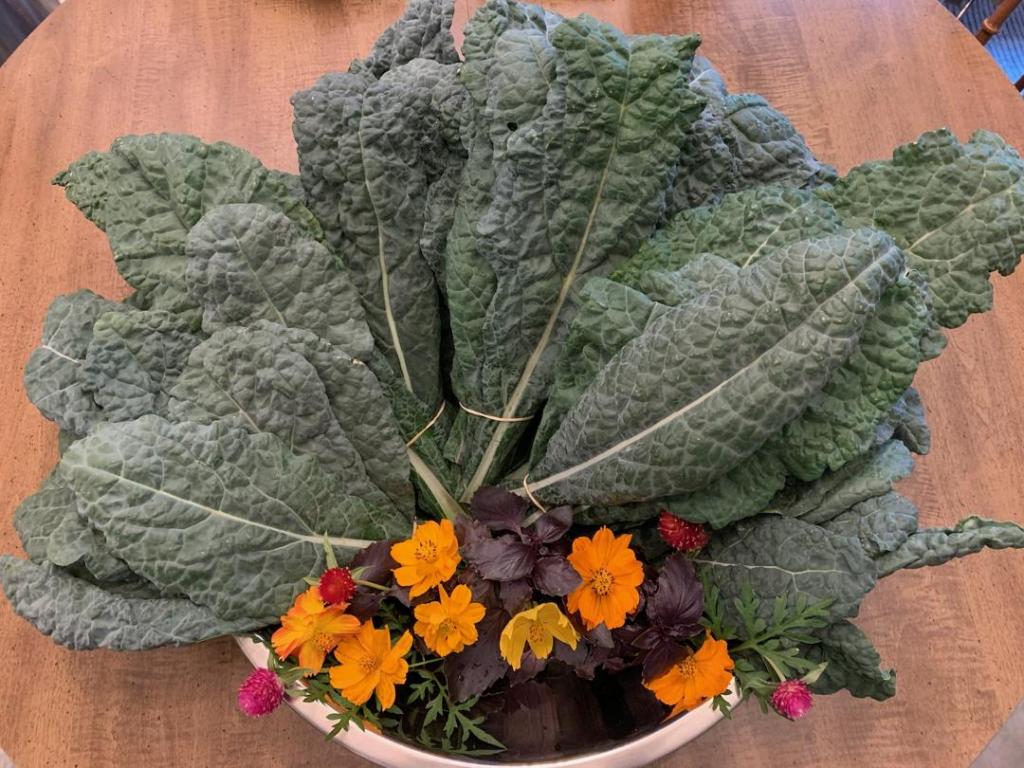
Happy New Year!!!

Activism, Airplanes, Communication, Community, Down On the Farm, Events, Farmers Markets, Food Deserts, Food Equality, Food Insecurity, Food Justice, Food Waste, Gardening, Health, Landfills, Marginalized, Neighbors, Non-Profits, Nutrition, Opal's Farm, Public Policy, Regeneration, Relationships, Service Organizations, Service to Others, Social Justice, Thoughts From the Porch, Transformation, Unity Unlimited, Inc., Urban Farming, Volunteers, What Can I Do

Urban Ag and You

A couple of weeks ago, my Monday morning meeting ended early, so I sat at the Philadelphia Airport waiting for four hours for my plane home. I’m not good at sitting but I have little choice over the next seven hours or so. It was nice to catch up on a few things, but I prefer the open fields and growing plants to rows of chairs and sitting in an airborne cigar…

I was here to attend the Black Urban Growers National Conference, or BUGs as they call it. Philly has a strong urban agriculture movement with many farms and community gardens dotting the city. They even have a Director of Urban Agriculture as part of the Parks and Recreation Department for the city government. It was great to make some connections with folks here. Hopefully, we can begin to move city government in Tarrant County, Fort Worth, and the surrounding cities to move in a positive direction for urban ag and community gardens. Jesse Herrera, Linda Fulmer, and Grow SE have moved us a long way but there’s so much to do to make Fort Worth favorable to urban agriculture and eliminating food insecurity.

Six cities currently have Urban Agriculture leaders in city government – Philadelphia, Atlanta (whose director also spoke at BUGs and was the first city in the nation to appoint a director), New York City, Detroit, Austin, Boston, Seattle, and Portland. These are also areas where there are strong food policy councils. However, each agreed that community member advocacy was essential to the formation of urban ag programs. These positions work through the mayor’s office, sustainability offices, parks, or planning departments. While Tarrant County has a food policy council, they need support from our community to have influence over policy decisions at the county or municipal level. We need is citizen support to drive progress forward for urban agriculture.

Why Urban Agriculture?

There are three primary reasons for establishing urban agriculture policies in Tarrant County municipalities – the number of food deserts, public health, and supply chain issues.

  • In 2020, NBC5 news reported that Tarrant County was one of the Top Ten counties in the country for food insecurity ( https://www.nbcdfw.com/news/local/fighting-hunger-urban-farming-in-fort-worths-food-desert/2292808/ ). Moreover, the USDA identified over forty areas in Tarrant County that qualify as “food deserts” – areas that are over a mile away from a grocery store. Food “desert’ is something of a misnomer. Food apartheid represented the concept far better as most of these areas are in lower income areas or communities of color. Urban agriculture and farmstands or farmers markets can make a significant impact on accessibility to fresh food in these neighborhoods. It can be costly under present urban farm and garden ordinances to build infrastructure needed for urban ag.
  • Public health is drastically affected by lack of access to healthy food. The zip code 76102 is the unhealthiest zip code in the state of Texas. Life expectancy is 66.7 years old – twelve years below the national average ( https://www.star-telegram.com/news/local/fort-worth/article244137362.html ). While lack of access to healthy food is not the only reason for poor health outcomes, it is certainly the root of the problem. In the Southside, Morningside, and Hillside communities there are only a dozen convenience stores that only sell snacks and highly processed canned foods lacking nutritional value. Locally grown, nutrient-dense fresh vegetables help the body’s own defenses against heart disease, high blood pressure, diabetes, cancers, and obesity that lead to shorter lifespans and higher medical costs. Costs borne by all of us.
  • The COVID pandemic revealed serious flaws in our present food systems. Who doesn’t remember the higher food prices and empty store shelves of many items we use every day. Breaks in the supply chain have serious consequences for the retail grocery stores. Our food travels an average of 1500 miles from the farm to your table. To reach your grocer, it has to be picked before it’s ripe, sprayed with preservatives, shipped by rail or by truck to a distribution center and delivered to each individual store. It lacks the flavor and nutrient density so many of us crave. Locally grown produce is a solution to this problem.

Moreover, local urban farmers develop a sense of community around the local farmer’s market or farmstand. The community gets to know their local farmers and their neighbors better. “Screen time”

Is often replaced by real conversations. A sense of neighborhood pride replaces some of the isolation that often plagues our senior citizens. Opal’s Farm has been a member of the Cowtown Farmers Market for five years now. We’ve developed a loyal customer base and we’ve come to know our customers as friends. We’ve been an active part of our community, and many folks have volunteered at the farm as well as become our customers.

What Can I Do?

Access to land is often easier than we think. Learn about urban agriculture in your neighborhood. Are there any community gardens? If not, is there a place for one? Are there vacant lots, churches, or schools that might be good sites for a small urban farm or community garden. Are there local learning gardens to offer growing tips and support to neighborhoods? Do your local schools have school gardens that you might volunteer with? Is there a place to gather to bring local farmers and gardeners together to offer their goods and services to the neighborhood?

Find out what the urban agriculture and community garden ordinances (or if you even have them) are in your municipality. Is zoning an issue? Neighborhood associations are often a great place to start if you have one. If not, local code compliance or development departments can provide guidelines.

Here in Fort Worth, urban agriculture ordinances were almost non-existent and what we did have was more of a barrier than a help. A local initiative by County Commissioner Brooks Office called Grow SE brought local non-profits and urban farmers together to address this issue. Grow SE worked diligently to address and change the city ordinances that limit urban ag and have made it much easier to build the infrastructure to make it successful but – we have a long way to go!

Get involved with your local food policy council. Food Policy Councils were first authorized in the 2014 Farm Bill and re-emphasized in the 2018 Farm Bill. If your city does not have one, then start one. Here in Tarrant County, we are fortunate to have a council with working groups in urban ag and food waste (a significant issue as Fort Worth faces having to build the infrastructure for a new landfill). Food policy councils can have a major effect on local food policy and urban agriculture.

Contact your local city council member and make your voice heard. Attend city council meetings and ask your neighbors to do so as well. Talk to your local officials and let them know this is a big issue to deal with. Changing the food system and delivery to your table begins at the local level!

I’m excited to be home and to continue our Fall growing and prepping for next Spring. I’d love to have you come out and start your urban agriculture journey with Opal’s Farm. Come see the possibilities for positive change here in Fort Worth and Tarrant County. Bring your kids. Kids (and unfortunately many adults) have no idea where their food comes from. Once they learn how good food is grown and distributed to our communities, they get excited to be a part of the process. The fresh air, vitamin D, and “playing in the dirt” is great for them (and for you!) Come and see!

Choices, Climate Change, Community, Consequences, Education, Equal Rights, Events, Faith, Food Equality, Food Insecurity, Food Justice, Gardening, Gratitude, Hope, Neighbors, Non-Profits, Nutrition, Opal's Farm, Preparation, Regeneration, Respect, Responsibility, Service to Others, Simplicity, Social Justice, Spirituality, Unity Unlimited, Inc., Urban Farming, What Can I Do

What is bio-intensive farming?

We are asked that question frequently as we move our first third of an acre to bio-intensive farming versus the “tractor” farming we have done for the first four years at Opal’s Farm.. The simplest definition of “bio-intensive farming” is to use organic methods to achieve “maximum yields from a minimum area of land, while simultaneously increasing biodiversity and sustaining the fertility of the soil.”( http://bionica.org/library/biointensive-method/ )

When properly implemented, bio-intensive farming has the potential to:

  • topsoil at a rate 60 times faster than in nature” (Worldwide Loss of Soil – and a Possible Solution Ecology Action, 1996).

At Opal’s, the third of an acre that is being transformed this Spring has 134 twenty-five-foot beds. Most of these beds are for tomatoes, peppers, and eggplants but they also contain some of our carrot crop, radishes, greens, and lettuces/salad mixes. Each of these beds yield produce equal to what our 100-foot rows have done in the past. We hope to add more bio-intensive beds over the coming growing seasons.

Bio-intensive means just that – intensive. Management of these beds requires constant attention, but even the time spent on each bed is lessened as the soil becomes cleaner (less weeds) and healthier. The system is perfect for the home gardener or small producer like Opal’s.

Building the infrastructure for bio-intensive farming is time-consuming. That’s one reason we have not utilized it in the past. We’ve simply not had the labor to build and maintain these beds in the past. Now that we’ve added Amber Carr and Amanda Vogel to our staff, we are able to change our focus, knowing that once the infrastructure is in place we never have to build it again! We’ll be sharing our successes with you over the coming Spring and long-term plans are to have educational classes available to the community.


Side Note!

I would be remiss if I didn’t tell you how much we appreciate the Natural Resource Conservation Service (NRCS). On February 23rd, they came in mass with engineers to help design a more efficient irrigation system for us. We already have drip irrigation for our bio-intensive section, but having more efficient water use over the whole farm is something we’ve been striving for since the beginning.

NRCS and its parent agency, the USDA, have begun to concentrate on urban agriculture and smaller producers in a big way. We can lead the way in developing practices and programs right here for future urban farms in North Texas. We would love to thank our Urban Agriculture representative, Michael Higgins, and our NRCS rep for this district, Michael Brookes, for the extra attention and help they are giving Opal’s and urban agriculture throughout the metroplex!

Community, Down On the Farm, Events, Faith, Farmers Markets, Fighting Poverty, Food Equality, Food Insecurity, Food Justice, Gratitude, Marginalized, Neighbors, Non-Profits, Opal's Farm, Relationships, Service to Others, Social Justice, Spirituality, Tarrant Regional Water District, Unity Unlimited, Inc., Urban Farming, Volunteers

The Phoenix Festival 2022

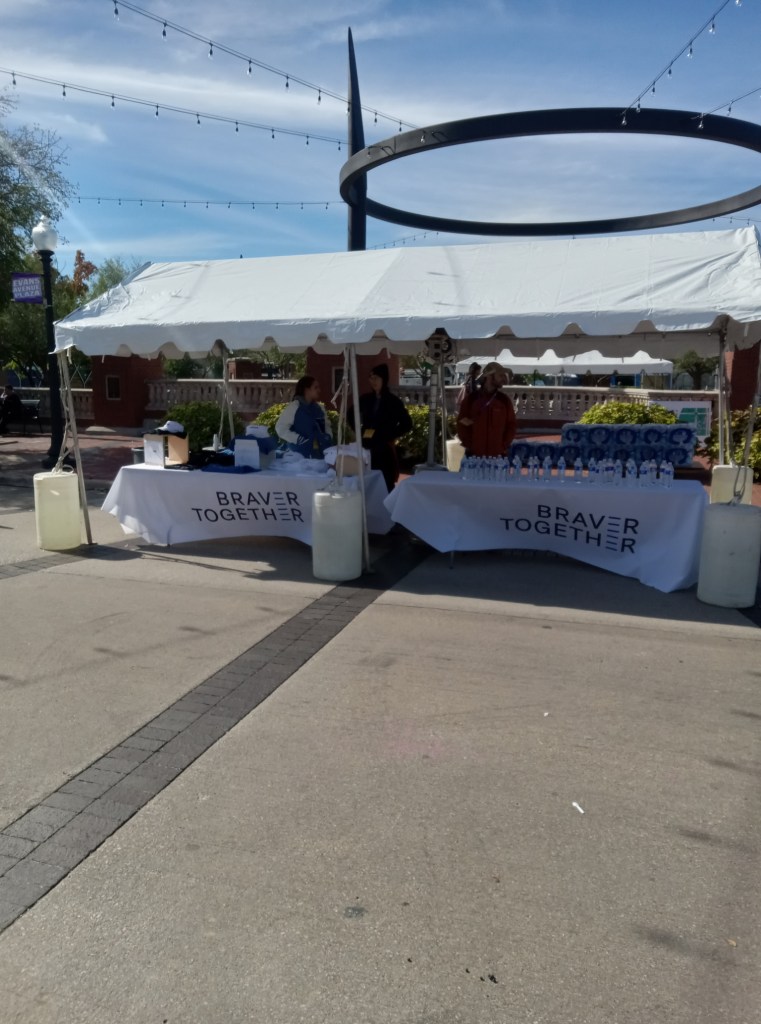
We may have woken to a chilly morning on Saturday, but the sun was shining, and it was a great day for the first Phoenix Festival at Evans Plaza! Thank you to Brave/R Together and the Tarrant County United Way for a fantastic day of vendors, events, and music for the benefit of the 76104 community. Thank you especially to Shawn Lassiter (and everyone at Brave/R) for putting it all together.

Opal’s Farm is happy to be a part of this effort to better serve our southside neighbors. CoAct was there, and Grow SE were represented by Black Wall Street, Ms. Jovetta, and Mind Your Garden MYG Urban Farm. Steve and Ursula Nunez (MYG) put on an amazing cooking demonstration that had many of our neighbors talking and buying fresh, nutritious produce from all the farms. We are looking forward to the next Phoenix Festival!

We’ll be right up the road next Saturday for the Funkytown Mindful Market at Texas Wesleyan University with tons of fresh produce for our neighbors in Poly Heights from 11-2!

Activism, Community, Donations, Down On the Farm, Events, Faith, Food Equality, Food Insecurity, Food Justice, Health, Hope, Marginalized, Neighbors, Non-Profits, Nutrition, Opal's Farm, Relationships, Role Models, Social Justice, Spirituality, Unity Unlimited, Inc., Urban Farming, Volunteers, What Can I Do

Day of Service

Happy Sunday and the beginning of October! Thank you to everyone who participated in the White House Conference on Food, Nutrition, and Health at the Watch Party on Wednesday. We are so thankful attention is being given to the food insecurity and the health issues that stem from it. The conversation has started and now is the time for action – changing how we think about food, giving access to healthy food for everyone, and pursuing food justice. This is 2022 – there is no reason that 1 in 5 of our kids goes to bed hungry each night.

One of the things that stood out to me the most is that the food advocacy community here in Tarrant County is already doing and growing into many of the actions the conference discussed. We are blessed to have a small but vibrant community of food advocates here in Fort Worth and Opal’s Farm is proud to be part of that community.

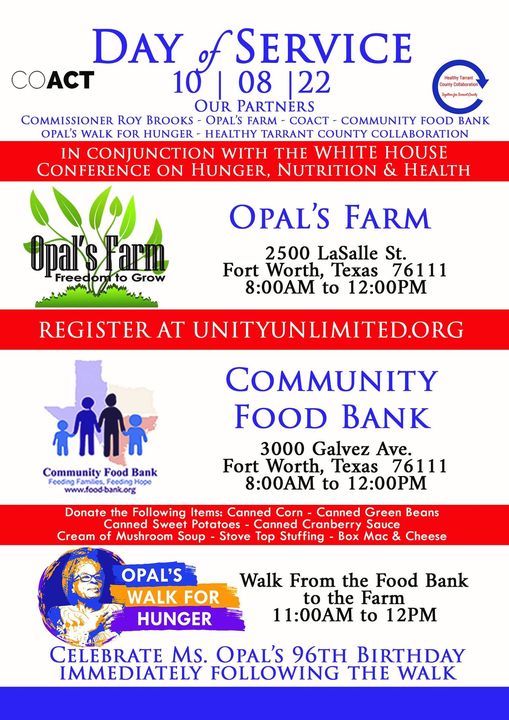
In support of the White House Conference and the Administration’s drive end hunger by 2030, Opal’s Farm will be hosting a Day of Service at both the Community Food Bank and Opal’s Farm. Not only will be doing some excellent service work at both places, but we will also be walking “Opal’s Walk for Hunger” from the Community Food Bank to the farm, immediately followed by a celebration of Ms. Opal’s 96th birthday! Please come and join the festivities.