
Category: Activism
Rain, Rain, Don’t Go Away – Just Come Less Frequently
It’s raining once again so that means it must be Sunday. I am so grateful for the rain – the plants at the farm love it – but it can be a mixed blessing. I have the rest of the Spring planting to do before it gets too hot! Then again, I got to take a nap this afternoon…
This has been another great week at Opal’s Farm. We’d love to thank the Bank of America volunteers that came out Wednesday. I was in Fayetteville, Arkansas for the Growing Hope conference and was amazed when I came home to see the work that had been done. Thanks to Stacey and Joey for all their hard work and making the volunteer event a great day.
As I mentioned, I was at the Growing Hope conference hosted by the National Center for Appropriate Technology (NCAT) in Fayetteville this week. It was an excellent conference reminding (and teaching) us of the importance of what we do as farmers and folks trying to change our local food systems.
I toured two different non-profit farms, Cobblestone Farms and Apple Seeds, and learned of our common mission to fight food insecurity and educate others – especially our kids – about healthy growing and real nutrition.
I also spoke with an amazing group of farmers and activists about the fight for food justice – not just food access and food security – but the justice that gives everyone a seat at the table (both literally and figuratively) to create safe, equitable local food systems. I’d love to give a shout out to all the folks at NCAT who put the conference together. It was one of the best conferences I’ve had the privilege of attending – full of new ideas and re-energizing me for the fight for food justice and equity.
The Presidential Medal of Freedom…
I get to take Sunday off once again. It’s been another rainy weekend here in Fort Worth so it’s far too muddy to get any serious work done at Opal’s Farm. We’ve been blessed by an abundance of rain this Spring, but it’s slowing the planting process. Don’t get me wrong. I’m grateful for the rain. Nothing is better for the farm than nature’s irrigation. The plants love it. I need to get the rest of the seed in to fully enjoy this wonderous time of year. The three-to-five-day rain cycle has really slowed things down.
I must apologize for not having the farm stand active yesterday. Opal’s Farm is in the transition period between early Spring and Summer crops and couldn’t harvest as much as normal. Everything sold at the Cowtown Farmers Market earlier in the day (and a special thanks to all the folks who braved the drizzly overcast day to come by). Please know the farm stand will be there next week with more fresh produce.
I must thank our Assistant Manager, Joey Hughes, for braving the rain and the mud all week to prepare and plant more beds. Joey is overseeing the biointensive section of the farm this year. He’s doing an amazing job expanding and keeping the section growing for our community.
I’d also like to give a shout out to our Volunteer Coordinator, Stacey Harwood, for doing the farm tours for all the kids and the parents who’ve visited the farm over the past few weeks. The farm is something near and dear to her heart and it shows in her excitement to tell everyone about Opal’s Farm.
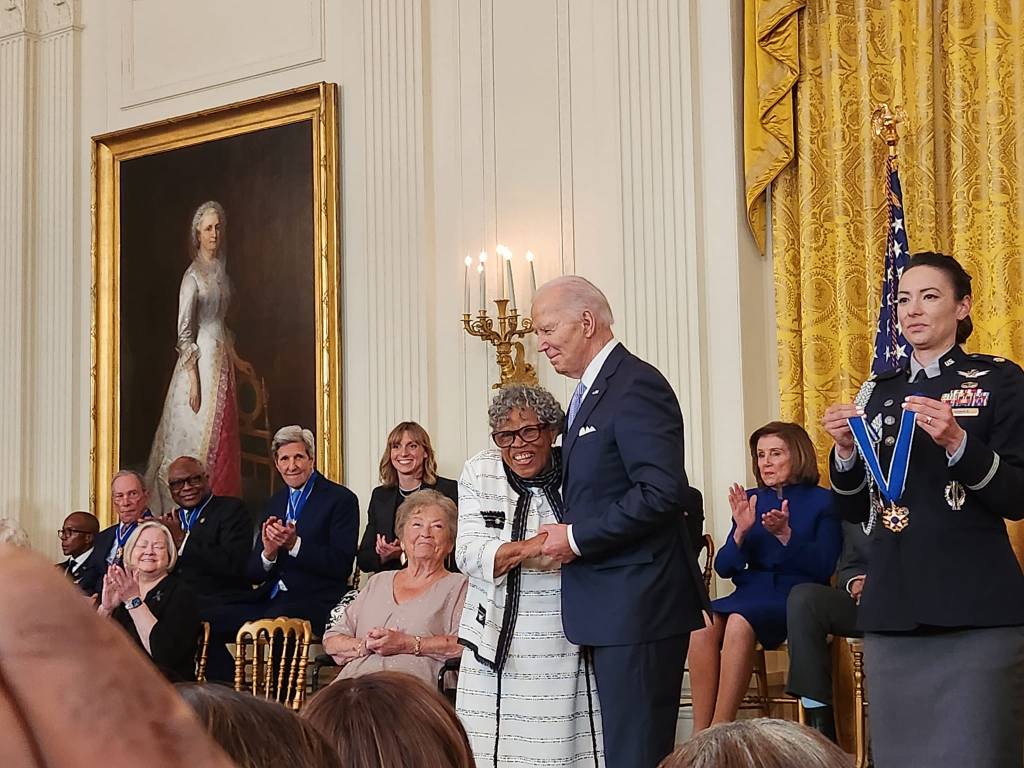
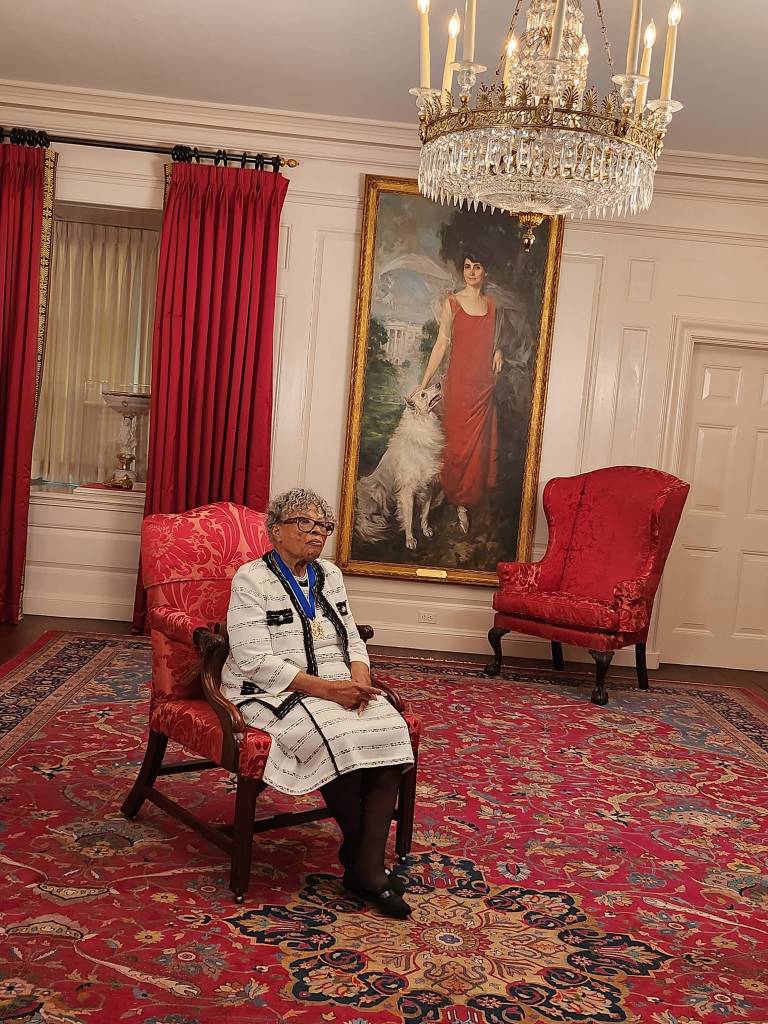
We finished the week in a big way. Our Executive Director, Dione Sims, accompanied Ms. Opal the Washington, D.C. where she was invited to the White House to receive the Presidential Medal of Freedom on Friday. Nineteen people were awarded the medal. Ms. Opal was in some awesome company the included Phil Donahue, former Vice-President Al Gore, and former Speaker of the House, Nancy Pelosi, among others. We applaud and offer our congratulations to all the recipients, but especially Ms. Opal Lee, our visionary and “Grandmother of Juneteenth”. The Presidential Medal of Freedom is the highest civilian honor in the country, and we can think of no one more worthy of that honor.
(* side note – you can watch the ceremony on https://www.c-span.org/video/?535394-1/2024-presidential-medal-freedom-ceremony )
Finally, this may not be a farm event, but I must tell you that I was able to go see my grandson, Lucas, perform in the District Orchestra Concert at I.M. Terrell Academy on Saturday afternoon. I’m so proud and I’m thrilled that he made district. Moreover, he played at a place special to me because that’s where Ms. Opal graduated high school and it’s such an important place in Fort Worth history. Thanks to Fort Worth ISD for its investment in expanding I.M. Terrell High School and honoring its historical significance.
The sun came out as I wrote this so I’m thinking it’s time to get busy. Have a blessed Cinco de Mayo and come see us at Opal’s Farm!
The clock is Ticking Again
It was sometime during the early years of the Reagan Administration. I can’t remember the date exactly, but I’ve never forgotten the events that night. It was clear and despite the city lights, the stars twinkled brightly on the late winter’s night. I had taken a moment to sit on our big front porch to take in the beauty of the evening before going to bed. I smoked my last cigarette of the day and shut off the lights as I walked through the living room, the kitchen, and down the back stairs to the warmth of our small bedroom in the basement.
Our house was an old farmhouse built in 1890 and sat on two large city lots. It was built long before the area known as Washington Park grew up around it and had much different architecture than the Craftsmen and Victorian homes that came in the early 1900s. It was small – only 950 square feet – and finished in stucco with a flat roof. It even had the old concrete path to where the outhouse would’ve been in its early years. The basement had been finished with two small bedrooms my first wife and I shared next to our boy’s bedroom. It always felt so cozy on a long winter’s night, and I rarely had insomnia issues after sliding into the inviting warmth of the covers and my wife’s arms. It wasn’t much but it was our piece of paradise in the middle of Denver’s urban sprawl.
I’m not sure of the exact time it happened but it was in the early morning hours when sleep is so deep that even one’s dreams are on hold. It was the kind of sleep that we all long for: peaceful and restful. It was also the deep sleep that made it virtually impossible to awaken with a clear mind – the mind remained in that state long after the body was jolted awake. That’s when it happened.
The long, loud scream of the warning sirens blew in the basement window; waning and ebbing as the siren made its circular motion. My wife and I sat up in bed. “What in the hell?”, I demanded as we looked at one another trying to figure out what was up.
I had grown up with warning sirens in Texas, but there we called them tornado sirens. They were tested monthly so if they ever went off other than 1:00 PM on the first Wednesday of the month it meant you needed to head for a place in your home away from windows and doors and hold on. A tornado was nearby and may hit you soon. North Texas marked the southern end of tornado alley. Growing up in Fort Worth meant having a solemn respect for tornado warnings.
The warning sirens were also called Civil Defense sirens. You see, I grew up during the Cold War between the Soviet Union Eastern Bloc and the West. Both sides had a first-strike capability with the ever-growing stockpile of nuclear weapons. The sirens warned us of an imminent attach by the godless communists. We were supposed to file into the basements of buildings marked as Civil Defense shelters if we were downtown working or shopping (this was BM – Before Malls). If we were elsewhere, such as school, we were supposed to “duck and cover” as if our trusty school desks were to help us survive a nuclear blast. I still remember Tommy Turtle and the black-and-white instructional films (this was BV – before video) that told us how to duck low to the ground, cover our heads, and look away from the blast in case of nuclear attack. It mattered little that we were to be vaporized or brutally burned when the bomb went off. The ostrich approach was probably the best way to go…
Unfortunately, this wasn’t North Texas but Denver, Colorado. In the all the years of junior and senior high school and college I had never heard a warning siren. Nor had I ever seen a tornado in Denver, especially in the winter. They just didn’t happen then (climate change changed that scenario years later). Even if they did, the city wouldn’t be testing the sirens at three o’clock in the morning, so something was going on. I reached over to our bedside alarm clock radio and tuned in to see if there was any news about what was happening. There wasn’t. Was this it? Was this the bomb?
The Cold War had a renewed tension after Reagan was elected President. Saber rattling had become the norm and tensions between East and West were at the highest point since the Cuban Missile Crisis in October of 1963. The nuclear arms race was in full swing. I had proudly been arrested for civil disobedience at the Rocky Flats Nuclear Weapons facility numerous times (once with Father Berrigan!). Nuclear disarmament and peace were the subjects of many a demonstration, however small those might be. Most folks were content to live in fear if it didn’t interfere with making a living and going about normal daily life. The warning sirens made everything suddenly real.
Maybe this was it. Denver would be a prime target in any attack scenario. It boasted the largest Federal center of anywhere outside of Washington, D.C. and was surrounded by Rocky Mountain Nuclear Arsenal, an Air Force Base, and several other military facilities. The likelihood that this would be our last few moments was real. My mind raced with memories of a recent movie sensation, “The Day After”.
Finally, the sirens stopped. My wife, though jolted awake by the sudden emergency, drifted back off to sleep. My boys never woke up through the whole affair. All things slowly returned to normal though I never quite made it back to sleep that night. It had all been too unsettling. The morning news carried a story about the event. It seems somehow water had gotten in a control room and shorted out the wiring, causing the alarms to go off. We were never in danger, only inconvenienced. The event was soon forgotten, and life went about as usual.
Several years later, the Berlin Wall came down, the Soviet Union fell apart and became the Russian Federation, and the Cold War was declared over. Anti-nuke demonstrations faded and the news media found plenty of other things to instill more fear and create more demonstrations over. There were new countries joining the nuclear weapon family. Although they had agendas contrary to the West there has not been the intensity of coverage, nor the fearfulness found in the Cold War years.
2024 is an election year. Many on both sides of the political spectrum say it’s the most important election in America history. I’ve lived long enough to have voted in several “most important” elections. This year really is different though, and for a myriad of reasons. I’ve heard all the arguments but the one that’s been missing is the threat of nuclear catastrophe that is now at its highest point since the 1980s. There may no longer be a Soviet Union but the Cold War between East and West has restarted and could become a “hot” war through miscalculation, misunderstanding, and miscommunication.
Authoritarian rulers like Putin have referred to the nuclear option several times over the last two years in his quest to restore Russian Empire. North Korea improves and expands its nuclear program while other international actors seek to be come nuclear powers. More and more uncertainties enter the equation.
I don’t like fear tactics and that’s not what I hope comes from this story. I hope that this is a subject to be taken seriously when considering election choices in the coming year. Whoever is elected will have the final say over whether we live together or die together. It’s important to consider deeply and prayerfully who we give that power to.
Evaluate real character and integrity. Choose those who demonstrate empathy and compassion for the common good rather than those whose decisions are made for themselves. Who holds up and lives out the values we strive for? Making America great again should be making America what it professes to believe in, and not some idea of selfish, power seekers only seek to make others do their will. Choose wisely. You lives may depend on it…
***I also recommend:
Turning Point: The Bomb and the Cold War available on Netflix
What’s Really There…
It’s a fantastic late winter/early spring (depending on whether you use the meteorological or the Spring Equinox calendar) day here in North Texas. I’m still reeling from the time change to Daylight Savings. It always gets me no matter how hard I try to plan for it. I’m just tired and don’t want to do much of anything so here I sit on this beautiful afternoon, drinking coffee, and feeling somewhat guilty I’m not out at the farm. Not yet anyway…
I took time to read a bit and catch a couple of lectures in my schoolwork. One of the articles I read was by one of my favorite authors and bloggers, John Pavlovitz. You can find him at https://johnpavlovitz.com/ I got turned on to him several years ago and when he started a social media network for people who still give a damn about things like empathy, compassion, and loving our neighbor I jumped to join. It’s a wonderful community of like-minded but unique individuals who come together to share about politics, organized religion, racial justice, activism and social justice, among many other things.
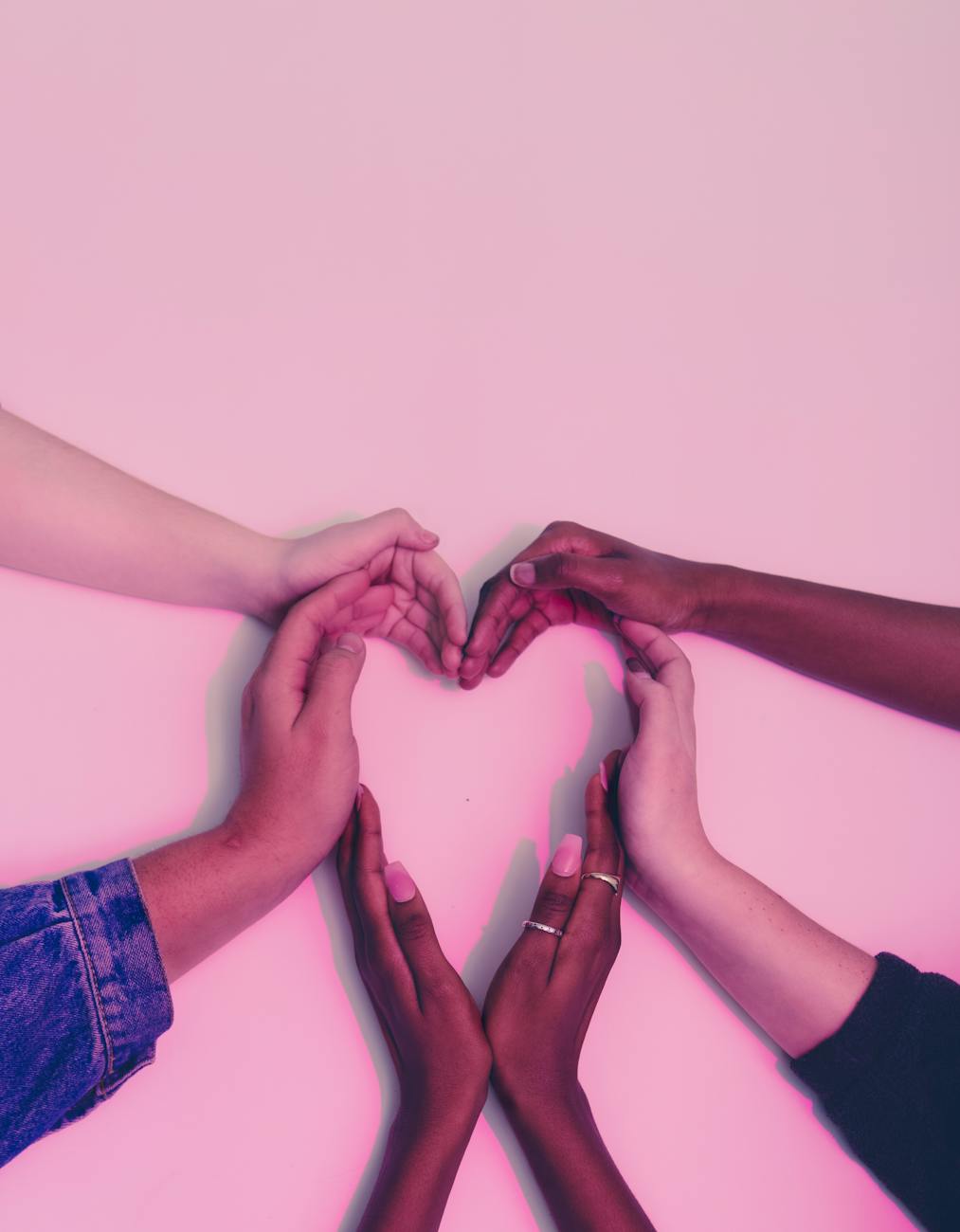
It gives me hope that people are still committed to loving our neighbors and the common good. That’s in short supply these days if you listen to the media and the extremists who tend to be much louder than most folks, that is. I choose to believe that most people aren’t filled with so much hate and vitriol as the far-right, the White Christian Nationalists, or the radical left for that matter. The media eats it up though. Extremism sells…
I would highly recommend John’s work to any of my fellows who believe the God is love, the Good News is just that, – Good News – and want to follow some good direction on just being a decent person. Love you guys!
 gregoryjoel.com