It’s a fantastic late winter/early spring (depending on whether you use the meteorological or the Spring Equinox calendar) day here in North Texas. I’m still reeling from the time change to Daylight Savings. It always gets me no matter how hard I try to plan for it. I’m just tired and don’t want to do much of anything so here I sit on this beautiful afternoon, drinking coffee, and feeling somewhat guilty I’m not out at the farm. Not yet anyway…
I took time to read a bit and catch a couple of lectures in my schoolwork. One of the articles I read was by one of my favorite authors and bloggers, John Pavlovitz. You can find him at https://johnpavlovitz.com/ I got turned on to him several years ago and when he started a social media network for people who still give a damn about things like empathy, compassion, and loving our neighbor I jumped to join. It’s a wonderful community of like-minded but unique individuals who come together to share about politics, organized religion, racial justice, activism and social justice, among many other things.
It gives me hope that people are still committed to loving our neighbors and the common good. That’s in short supply these days if you listen to the media and the extremists who tend to be much louder than most folks, that is. I choose to believe that most people aren’t filled with so much hate and vitriol as the far-right, the White Christian Nationalists, or the radical left for that matter. The media eats it up though. Extremism sells…
I would highly recommend John’s work to any of my fellows who believe the God is love, the Good News is just that, – Good News – and want to follow some good direction on just being a decent person. Love you guys!
The 16th would’ve been Dad’s 99th birthday. I’ve been thinking of him a lot this week. I always think about his words of wisdom and his love for his family, but January 16th is extra special. For the last ten or fifteen years of his life he worked with his friend Jesse at the Fort Worth Stock Show & Rodeo every year. It was an annual tradition that always kept us from celebrating his birthday until the second week of February.
Starting a week before the show opened, he would work twelve-hour days until the show was over by the second week of February. I couldn’t understand why he would work so much for close to minimum wage without a day off. That is, until I spent part of the day with him.
There are a couple of things you need to know about the Fort Worth Stock Show and Rodeo. First, it’s the oldest continuously running stock show in the United States. The formal name is the Southwest Exposition and Stock Show. It had its humble beginnings in 1896 to show the local citizens the livestock local cattlemen produced. Its stated aim was primarily educational and soon became an annual event. In 1907, the Stock Show charged admission for the first time – twenty-five cents – and in 1908 moved into the palatial Northside Coliseum in the Fort Worth Stockyards. Rodeos are still held there today on a weekly basis with kids admitted free or half-price making a fun family event.
In 1918, the first “World’s Original Indoor Rodeo” was held as a “strictly a contest” and the name “Southwest Exposition and Fat Stock Show” became the official event name. The only time the event has been cancelled was in 1943 when all America’s resources went to the war effort. In 1944 the stock show was moved to the Will Rogers Coliseum built for the Texas Centennial in 1936 where the stock show has remained (with massive infrastructure improvements) to this day. The Rodeo competition has been moved to the new Dickies Arena on the Stock Show grounds.
The year I was born, 1958, was the first year the event was televised. I don’t remember the first time my dad took me to the Stock Show and Rodeo, but it became an annual event for my dad and I. My grandmother worked as a seamstress for Mr. Wimberly, who owned the Army Store, a surplus store in downtown Fort Worth. Mr. Wimberly saw to it that we received tickets every year. He also raised, and showed, champion Appaloosa horses. Rustler Bill was a National Champion and I got to “ride” him every year. That is, I got to sit on him while Mr. Wimberly walked me through the stables. It was a young cowboy’s dream!
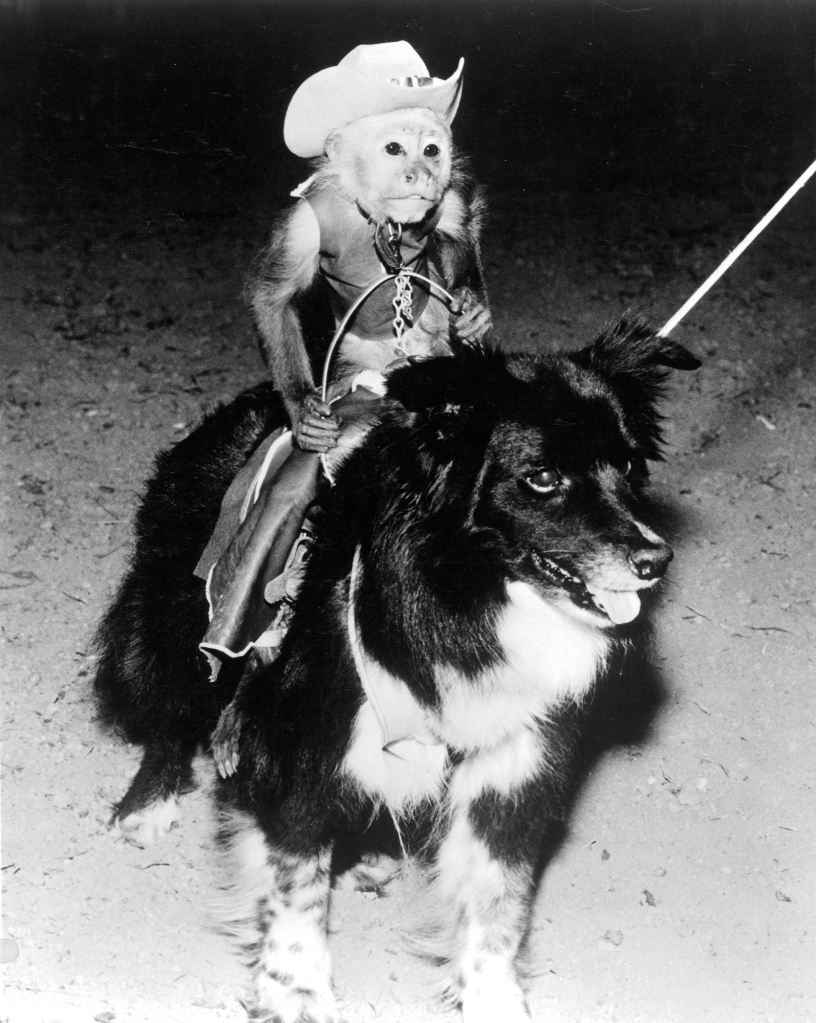
My childhood memories are sparse, but I always remember the Stock Show and Rodeo. The first memory was of Zippy the monkey and his Scottish Sheepdog. Zippy would ride around the arena at full speed and then stop and herd sheep. How could anyone forget a monkey cowboy?
from the FWSSR Archives
In 1969, my dad was transferred to Denver, Colorado. We tried attending the Denver National Western Stock Show, but it just wasn’t the same. We went three or four times to no avail and soon, I never went again.
Fast forward to 1986 when I moved home to Fort Worth. I was going through a divorce and had custody of my two boys, Adrian and Jeremy. My dad must have known a cure for the break-up blues because a month after we moved back our annual trips to the Stock Show began again. This time it was to establish a tradition for the boys.
My father had started working the Stock Show every year with his lifetime friend Jesse. The boys and I would walk to his little shed by the gate, talk with Dad and Jesse, and walk through the livestock barns and exhibit halls. Because the vendors used Dad’s gate, we got a lot of free food for the three-week run of the show. I’ve never had so much pizza, barbeque, and Mrs. Baird’s pastries in my life. The boys loved it. Dad would keep them supplied in sweets every Saturday for the rest of the year, at least until Jeremy told my mom about the “diet” ice cream they ate. The tradition lived on until the boys got older and my addiction kept me away from the things I always loved.
The boys went their separate ways. Jeremy became a respected artist and wasn’t much interested in the old, Fort Worth tradition. Adrian must’ve received more of the cowboy DNA because he trained cutting horses and worked a ranch for several years. Today he serves the veteran community with One Tribe Foundation.
I don’t know how many years Dad worked those four weeks in the winter each year. He and Jesse both decided to retire when they both encountered some health issues. It wasn’t long before Dad passed. I didn’t get clean and into recovery until a couple of years later. If I had not had a father that loved me like Dad, I’m not sure I would’ve even gotten clean. If Dad, a mere human could radiate love and grace as he did, how much more so could a loving God.
I tried to continue the tradition with my grandkids, but it’s been sporadic at best. They’re just not into it. I guess wanting to be a cowboy isn’t in the aspirations of their generation. Why would they? There are no John Waynes anymore, tractors aren’t sexy, and ranching (and farming) seem to be an old people thing. The average age for a farmer in Texas is sixty-two. I tell everyone I’m finally above average at something.
I attend the Stock Show and Rodeo today to honor Dad and carry on an old Fort Worth tradition. I think of him while I’m there and remember so many wonderful things from long ago. I don’t go every year – the farm and weather change my plans more than they used to. Plus, crowds are getting harder to deal with as I’ve gotten older. Quite frankly, the crowds aren’t the same. Stock show attendance reaches record crowds almost every year. A lot of folks have moved to Fort Worth over the last few years, and they don’t always feel the tradition like native Fort Worthians do.
I also love to go with Ms. Opal to the Cowboys of Color Rodeo. In 2001, Jim Austin founded the National Multicultural Western Heritage Museum in the historic stockyards. In 2010, Fort Worth finally got around to honoring and recognizing the rich heritage of the Black and Brown community to both the city and the West by holding the first Cowboys of Color Rodeo. Ms. Opal has shared a history of Fort Worth I was never taught in my all-white schools. I’m thrilled to learn a history so rich that I might’ve missed had it not been for my work with her and Unity Unlimited. Inc. I hope to share the same with others. Full history brings us to reconciliation and justice.
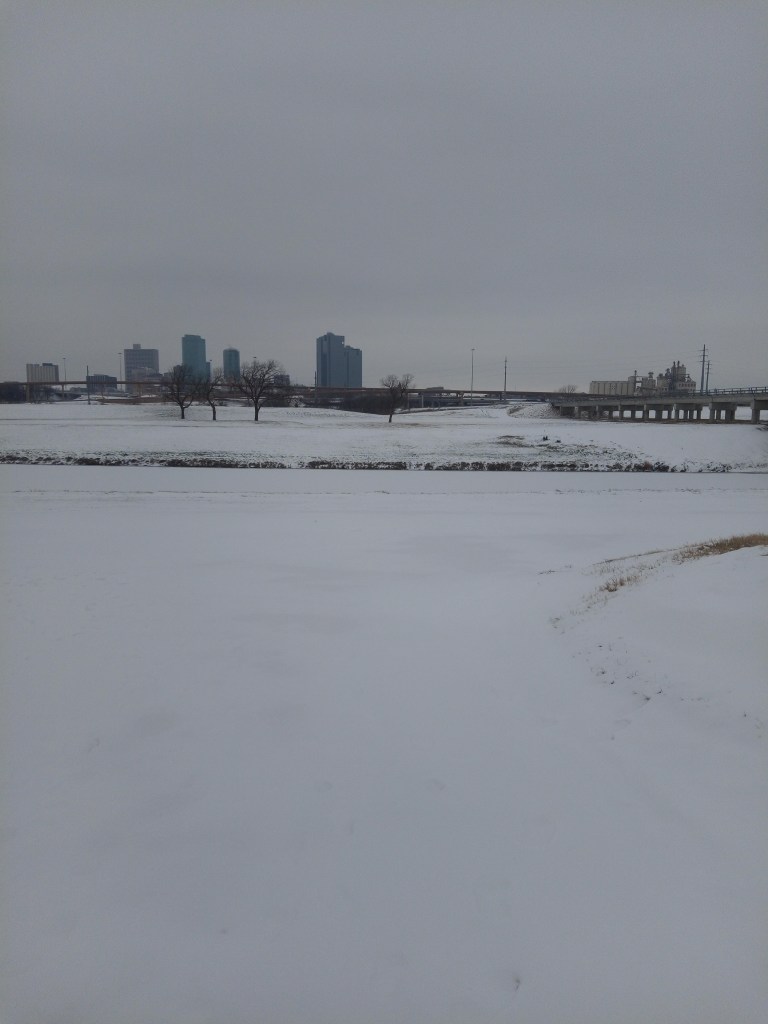
The scene beyond my window is rather drab. A blast of cold Arctic air exploded across North Texas yesterday afternoon. It brought with it the cutting icy North wind that plagues the Southern plains every winter. The “feels like” temperatures this morning were in the single digits and they’re predicting eighty-plus hours below freezing and sleet for this evening. Folks in these parts are understandably nervous. Ice brings out the worst in Texas drivers and the memory of Winter Storm Uri in 2021 is still fresh to anyone who lived here then. The power grid crashed, Texans went for days without power and water, and 246 people died from storm-related issues.
Last year saw a major ice storm at the end of January. We were at the Texas Organic Farmers and Gardeners Association Conference in Dallas and left early because of the roads. One of our employees ended up staying at the motel that night. One night turned into a week. Texans do not do well in cold weather. It doesn’t storm often but when it does look out!
Fortunately, we’ve had ample time to prepare for this Arctic visitor. Store shelves are empty of non-perishables and bottled water. Gas tanks are full and homes lucky enough to have a generator are standing by. People take the weather forecast a bit more seriously since the winter of ’21.
( Opal’s Farm and the frozen Trinity River February 2021 )
Personally, I haven’t had much time to prepare our house. I still must make a run to Home Depot. My neighbor said they had some outdoor faucet covers hidden in the back of the store. Information like that is like finding gold. We try to take care of each other in our neighborhood. I have, however, taken steps to prepare Opal’s Farm the best we can to save our winter crops. Frost cloth has been double-spread on the bio-intensive section and several of the hundred-foot rows. Prayers have been said, fingers have been crossed, and if I had a rabbit’s foot, I’m sure I’d be holding it close. We’ll keep you posted…
On a lighter, and somewhat warmer note (it was cool but warmer yesterday), we moved Opal’s Farm Stand hours to Saturday afternoons from 1:30 PM to 4:00 PM. We found his to be more convenient for our neighbors and the traffic on Sylvania isn’t rushing between jobs. We had several customers yesterday afternoon. This complements our mornings at Cowtown Farmers Market and our delivery for Hao’s Grocery and Café. We can harvest once a week to bring quality fresh produce to our community.
Anyway…
My fur-babies don’t seem to be bothered by the single-digit temperatures. They are out running around and playing as I sit here. Sitting here watching them got me to thinking about this blog. I’ve always called it “Thoughts From the Porch” because that was the place my thoughts and coffee ran freely since this journey began. I no longer spend my mornings on the front porch. It’s not because it’s cold. When you smoke it really doesn’t matter if it’s the summer Texas heat or the winter freeze, you’re driven to suffer outside.
However, that changed on November 1st of last year. That’s the day I quit smoking. I’ve been cigarette-less since then. The cravings have become less severe most of the time. The operative word being “most”. Other days – not so much. Staying off the porch has been a good move so here I sit. I still get a good view of the world through the patio door next to my office. It’s a constant reminder of God’s goodness and grace in our lives.
Maybe it’s time to find another name for this? Let me know your thoughts!
Please stay warm and safe through this cold snap. Stay inside, make it a family day or a day of introspection. Enjoy the time and pray the lights don’t go out…
My inbox has been filled with “Best of 2023” lists from the various writers and organizations I follow. As 2023 winds down I find myself thinking about all the wonderful things that have happened at Opal’s Farm and the ups and downs of the past year I’ve encountered personally. So, with that in mind I present to you the Best of 2023 for Opal’s Farm.
Ms. Opal
The biggest happening at the farm is always Ms. Opal herself. Each passing year reminds me of the blessing of her presence. Her love for others, her stamina and exhortations to become a “committee of one”, and her tireless work for our community revitalize us daily to make the farm the place to come for food, education, and the promise of food justice. She constantly reminds us that the walk toward equality and justice is one step and often with one person at a time. Our energy is always revitalized by her leadership.
Tomorrow my wife and I will celebrate New Year’s Day the way we have since I started at Opal’s Farm. At two in the afternoon, we’ll be present for her New Year’s Day dinner – along with a couple of hundred others! When we received the RSVP invitation it listed her accomplishments in 2023 so I’ll share them here:
Texas Senate portrait reveal – hers is only the second woman’s portrait to hang in the Texas Senate Chamber. The other is Congresswoman Barbara Jordan.
Three honorary doctorates
Two events with Cynt Marshall of the Dallas Mavericks
Several assemblies at schools with young people
Conversation with Brian Stevenson for the National Juneteenth Museum
Several visits to the White House
Visit with the Governor to talk about the National Juneteenth Museum
Reveal of portrait for the National Art Gallery
Inducted into the Texas Women’s Hall of Fame
Received two EMMY Awards – both the Governor’s Award and the Award for best documentary
New Awareness
Ms. Opal also visited the USDA People’s Garden in Washington DC and was featured in a national article for the USDA Natural Resource Conservation Service (NRCS). Both our Executive Director, Dione Sims, and I were invited to a roundtable discussion with Congressman Marc Veasy and US Department of Agriculture, Xochitl Torres Small along with a small group of local non-profits and City Council members.
The USDA is beginning to take a serious look at both local and urban farms and our food system. They opened their Urban Farm office in Dallas this year – one of ten cities to have one. Opal’s is by no means the only urban farm in Fort Worth, but we have had the privilege of hosting the NRCS staff for our area several times as they learn and extend their work to urban agriculture.
NRCS engineers have given us new plans and specifications for better irrigation at the farm. We are changing our irrigation over the winter months so we can grow more food for our community.
New and Old People
The Spring growing season was a time of transition for Opal’s Farm. Our previous Assistant Farm Manager, Amber Carr, helped build the infrastructure for our bio-intensive third-of-an-acre. She left the farm in July, and we were blessed to have Joseph (Joey) Hughes step in this Fall to take over our bio-intensive section. Joey came to us from World Hunger Relief in Waco and has an extensive background in education and urban agriculture. We’ve extended our programs to include agrotourism and educational programs for the community. We’ve also partnered with Delve Experience to a make tours and education more accessible through their website https://delveexperiences.com/ .
We’ve continued to build our partnership with Tarleton State University. In the coming year two new programs for both the community and previously incarcerated individuals will begin. We are presently finishing the curriculum and the final details. We’re excited to share this with you as 2024 begins (more to come!).
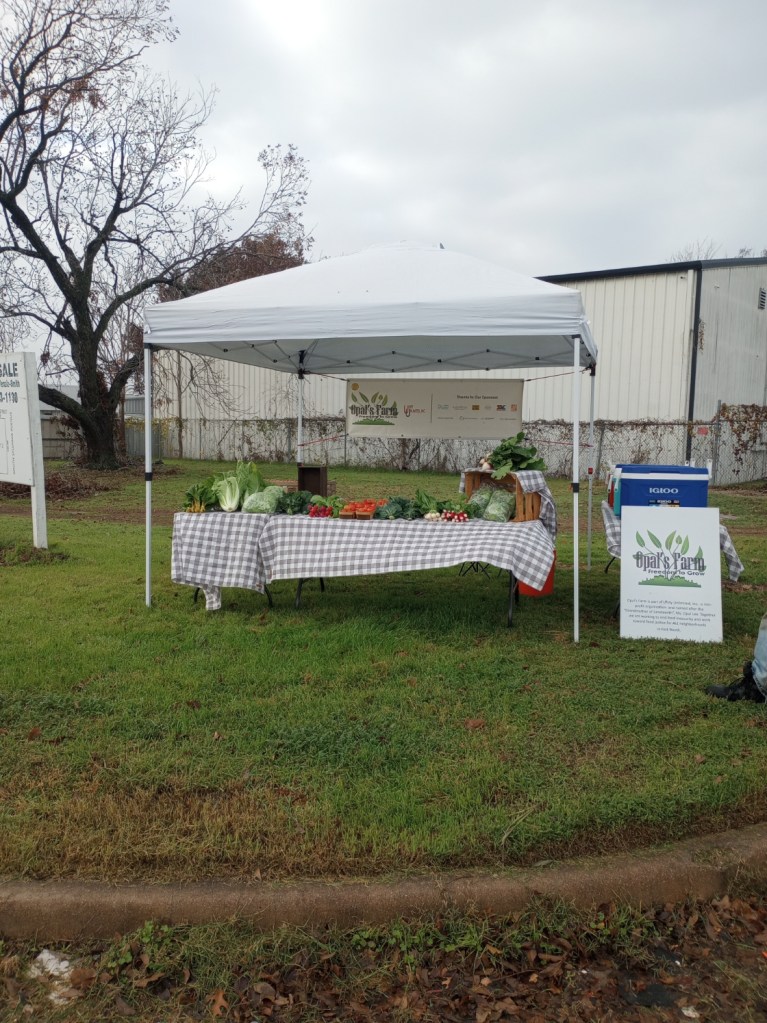
On Friday, December 22nd, we held our first-ever farmstand at the corner of Sylvania and LaSalle near the entrance to the farm. We are now able to support a regular farmstand on a weekly basis for the United Riverside neighborhood of which we are proud to be a part of (you don’t have to be a neighbor to come!). We are presently open from 10 AM to 2 PM but this might change as we get more input from our neighbors.
We’ve long hoped to be able to have our own farm stand and the final incentive came in November when we became authorized to accept SNAP benefits. This has been a game-changer for meeting our community goals. Please feel free to come by and check us out. You can tour Opal’s Farm while you’re there.
We’ve had some awesome volunteers this year and particularly this Fall. Stacey Harwood returned from medical leave as our Volunteer Coordinator in September and has done an amazing job getting some big projects done. We’ve had more time this Fall to plant more hundred-foot beds and expand our biointensive beds. We could not have done it without our volunteers and Stacey’s help. We want you to know how treasured and appreciate our volunteers are. You make the farm complete!
There have been so many things that have made 2023 a successful and major growth year at the farm. I have no doubt I’ve left some significant moments out. What I can tell you is that donors really stepped up this year to make 2023 and the coming year special. We’d like to thank the Enterprise Foundation with Enterprise Car Rental and the Stewart Family Foundation for the special awards that will keep Opal’s Farm expanding through 2024. We’d also like to thank KPMG Inc. and JP Morgan Chase for their continued support!
I cannot finish the “Best of” list without a thanks to our Executive Director, Dione Sims. We are a program of Unity Unlimited, Inc. and Unity’s support and belief in Opal’s Farm is what drives us. Dione spends many hours with all the various programs Unity does throughout the year, but she always has time for the farm. Thank you, Dione, for being an awesome leader, a friend, and a mentor!
On a personal note…
This past year has been incredibly hectic. It’s often difficult to “stop and smell the roses”. I, for one, have learned the value of tasking time to count God’s blessings. I am one of the most fortunate people I know. I get to go play in the dirt – to do what I truly love and am passionate about – and I get to do it every day.
Any kind of farming, whether it be urban or rural, is hard, but rewarding work. On the 110 degree days in August I ask the same question – why do I do this stuff? Then, I go to the markets we attend, and I get to see and know the people we serve. You all have made the year wonderful.
I hope and pray that 2024 brings you all joy, peace, and happiness. Thank you for being part of the Opal’s Farm family.
It’s Christmas Eve morning and the rain is falling outside the window of my humble home office. God provided a wonderful Christmas present for Opal’s Farm this year (He always does!). Even after some earlier Fall rains we’ve remained in various stages of drought. We got an inch-and-a-half on Thursday and it looks like another inch or two today!
We had our first farm stand market on Friday from 10 AM to 2 PM. It was a great success and we’re looking forward to being there on Friday’s starting after the first of the year. We can accept SNAP benefits as well. We’re excited! We’ll continue to be at Cowtown Farmers Market on Saturday mornings but serving our neighborhood – United Riverside – is what we’ve worked toward since the farm began.
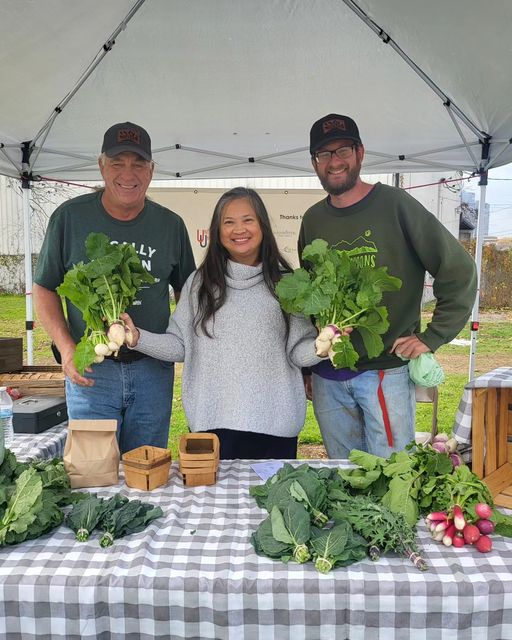
Joey, Hao and I on our first farm stand day!
We didn’t have a lot of customers as this was our first day, but the customers we did have made it a tremendously successful day. One of the neighborhood members stopped and purchased for themselves and then bought several bags of truly local produce to pass out to his neighbors! What a Christmas present!
We also had the privilege of meeting Hao Tran Friday. Many of you may know about Hao’s Grocery and Café. We’re so excited to have Hao as one of our supporters and customers. She is bringing fresh, LOCAL, produce to Fort Worth and teaching the importance of fresh produce as well as how to prepare it (She’s a culinary instructor at Trimble Tech High School as well.
The Fall and overwinter crops are booming! Please come out to see us next week at Cowtown Farmers Market and then stop by our farm stand the following Friday and visit Opal’s Farm as well!
From all of us at Opal’s Farm and Unity Unlimited, Inc. – have a wonderful holiday and keep family and friends close.

 gregoryjoel.com