Activism, Airplanes, Communication, Community, Down On the Farm, Events, Farmers Markets, Food Deserts, Food Equality, Food Insecurity, Food Justice, Food Waste, Gardening, Health, Landfills, Marginalized, Neighbors, Non-Profits, Nutrition, Opal's Farm, Public Policy, Regeneration, Relationships, Service Organizations, Service to Others, Social Justice, Thoughts From the Porch, Transformation, Unity Unlimited, Inc., Urban Farming, Volunteers, What Can I Do

Urban Ag and You

A couple of weeks ago, my Monday morning meeting ended early, so I sat at the Philadelphia Airport waiting for four hours for my plane home. I’m not good at sitting but I have little choice over the next seven hours or so. It was nice to catch up on a few things, but I prefer the open fields and growing plants to rows of chairs and sitting in an airborne cigar…

I was here to attend the Black Urban Growers National Conference, or BUGs as they call it. Philly has a strong urban agriculture movement with many farms and community gardens dotting the city. They even have a Director of Urban Agriculture as part of the Parks and Recreation Department for the city government. It was great to make some connections with folks here. Hopefully, we can begin to move city government in Tarrant County, Fort Worth, and the surrounding cities to move in a positive direction for urban ag and community gardens. Jesse Herrera, Linda Fulmer, and Grow SE have moved us a long way but there’s so much to do to make Fort Worth favorable to urban agriculture and eliminating food insecurity.

Six cities currently have Urban Agriculture leaders in city government – Philadelphia, Atlanta (whose director also spoke at BUGs and was the first city in the nation to appoint a director), New York City, Detroit, Austin, Boston, Seattle, and Portland. These are also areas where there are strong food policy councils. However, each agreed that community member advocacy was essential to the formation of urban ag programs. These positions work through the mayor’s office, sustainability offices, parks, or planning departments. While Tarrant County has a food policy council, they need support from our community to have influence over policy decisions at the county or municipal level. We need is citizen support to drive progress forward for urban agriculture.

Why Urban Agriculture?

There are three primary reasons for establishing urban agriculture policies in Tarrant County municipalities – the number of food deserts, public health, and supply chain issues.

  • In 2020, NBC5 news reported that Tarrant County was one of the Top Ten counties in the country for food insecurity ( https://www.nbcdfw.com/news/local/fighting-hunger-urban-farming-in-fort-worths-food-desert/2292808/ ). Moreover, the USDA identified over forty areas in Tarrant County that qualify as “food deserts” – areas that are over a mile away from a grocery store. Food “desert’ is something of a misnomer. Food apartheid represented the concept far better as most of these areas are in lower income areas or communities of color. Urban agriculture and farmstands or farmers markets can make a significant impact on accessibility to fresh food in these neighborhoods. It can be costly under present urban farm and garden ordinances to build infrastructure needed for urban ag.
  • Public health is drastically affected by lack of access to healthy food. The zip code 76102 is the unhealthiest zip code in the state of Texas. Life expectancy is 66.7 years old – twelve years below the national average ( https://www.star-telegram.com/news/local/fort-worth/article244137362.html ). While lack of access to healthy food is not the only reason for poor health outcomes, it is certainly the root of the problem. In the Southside, Morningside, and Hillside communities there are only a dozen convenience stores that only sell snacks and highly processed canned foods lacking nutritional value. Locally grown, nutrient-dense fresh vegetables help the body’s own defenses against heart disease, high blood pressure, diabetes, cancers, and obesity that lead to shorter lifespans and higher medical costs. Costs borne by all of us.
  • The COVID pandemic revealed serious flaws in our present food systems. Who doesn’t remember the higher food prices and empty store shelves of many items we use every day. Breaks in the supply chain have serious consequences for the retail grocery stores. Our food travels an average of 1500 miles from the farm to your table. To reach your grocer, it has to be picked before it’s ripe, sprayed with preservatives, shipped by rail or by truck to a distribution center and delivered to each individual store. It lacks the flavor and nutrient density so many of us crave. Locally grown produce is a solution to this problem.

Moreover, local urban farmers develop a sense of community around the local farmer’s market or farmstand. The community gets to know their local farmers and their neighbors better. “Screen time”

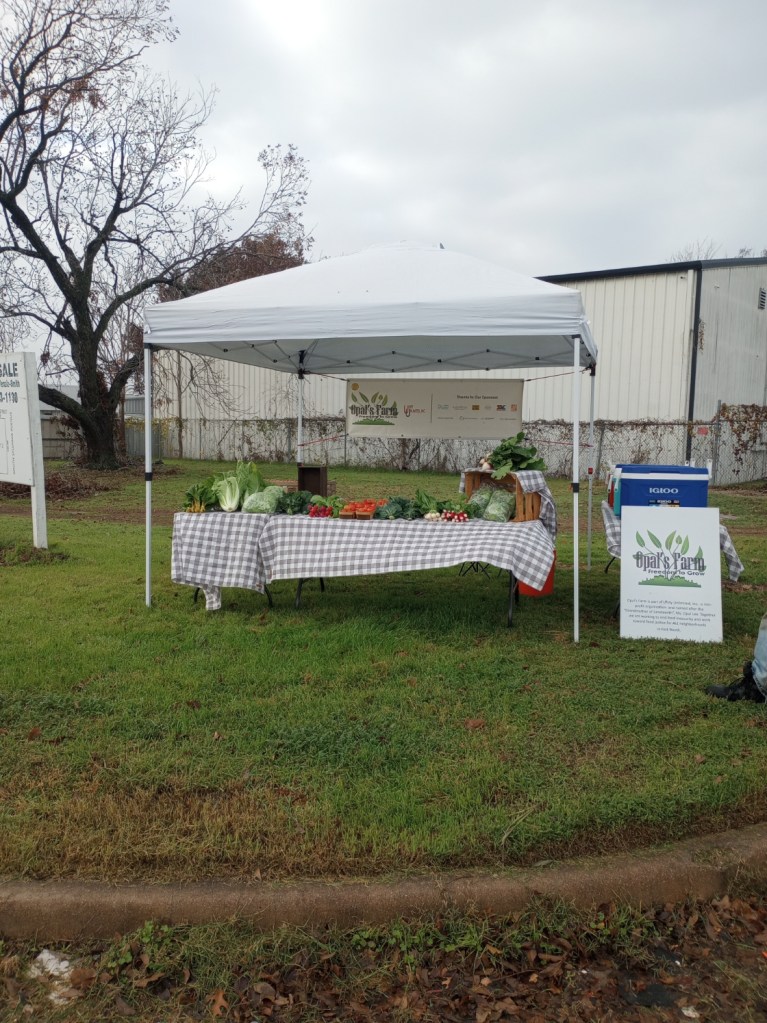
Is often replaced by real conversations. A sense of neighborhood pride replaces some of the isolation that often plagues our senior citizens. Opal’s Farm has been a member of the Cowtown Farmers Market for five years now. We’ve developed a loyal customer base and we’ve come to know our customers as friends. We’ve been an active part of our community, and many folks have volunteered at the farm as well as become our customers.

What Can I Do?

Access to land is often easier than we think. Learn about urban agriculture in your neighborhood. Are there any community gardens? If not, is there a place for one? Are there vacant lots, churches, or schools that might be good sites for a small urban farm or community garden. Are there local learning gardens to offer growing tips and support to neighborhoods? Do your local schools have school gardens that you might volunteer with? Is there a place to gather to bring local farmers and gardeners together to offer their goods and services to the neighborhood?

Find out what the urban agriculture and community garden ordinances (or if you even have them) are in your municipality. Is zoning an issue? Neighborhood associations are often a great place to start if you have one. If not, local code compliance or development departments can provide guidelines.

Here in Fort Worth, urban agriculture ordinances were almost non-existent and what we did have was more of a barrier than a help. A local initiative by County Commissioner Brooks Office called Grow SE brought local non-profits and urban farmers together to address this issue. Grow SE worked diligently to address and change the city ordinances that limit urban ag and have made it much easier to build the infrastructure to make it successful but – we have a long way to go!

Get involved with your local food policy council. Food Policy Councils were first authorized in the 2014 Farm Bill and re-emphasized in the 2018 Farm Bill. If your city does not have one, then start one. Here in Tarrant County, we are fortunate to have a council with working groups in urban ag and food waste (a significant issue as Fort Worth faces having to build the infrastructure for a new landfill). Food policy councils can have a major effect on local food policy and urban agriculture.

Contact your local city council member and make your voice heard. Attend city council meetings and ask your neighbors to do so as well. Talk to your local officials and let them know this is a big issue to deal with. Changing the food system and delivery to your table begins at the local level!

I’m excited to be home and to continue our Fall growing and prepping for next Spring. I’d love to have you come out and start your urban agriculture journey with Opal’s Farm. Come see the possibilities for positive change here in Fort Worth and Tarrant County. Bring your kids. Kids (and unfortunately many adults) have no idea where their food comes from. Once they learn how good food is grown and distributed to our communities, they get excited to be a part of the process. The fresh air, vitamin D, and “playing in the dirt” is great for them (and for you!) Come and see!

Choices, Climate Change, Community, Consequences, Education, Equal Rights, Events, Faith, Food Equality, Food Insecurity, Food Justice, Gardening, Gratitude, Hope, Neighbors, Non-Profits, Nutrition, Opal's Farm, Preparation, Regeneration, Respect, Responsibility, Service to Others, Simplicity, Social Justice, Spirituality, Unity Unlimited, Inc., Urban Farming, What Can I Do

What is bio-intensive farming?

We are asked that question frequently as we move our first third of an acre to bio-intensive farming versus the “tractor” farming we have done for the first four years at Opal’s Farm.. The simplest definition of “bio-intensive farming” is to use organic methods to achieve “maximum yields from a minimum area of land, while simultaneously increasing biodiversity and sustaining the fertility of the soil.”( http://bionica.org/library/biointensive-method/ )

When properly implemented, bio-intensive farming has the potential to:

  • topsoil at a rate 60 times faster than in nature” (Worldwide Loss of Soil – and a Possible Solution Ecology Action, 1996).

At Opal’s, the third of an acre that is being transformed this Spring has 134 twenty-five-foot beds. Most of these beds are for tomatoes, peppers, and eggplants but they also contain some of our carrot crop, radishes, greens, and lettuces/salad mixes. Each of these beds yield produce equal to what our 100-foot rows have done in the past. We hope to add more bio-intensive beds over the coming growing seasons.

Bio-intensive means just that – intensive. Management of these beds requires constant attention, but even the time spent on each bed is lessened as the soil becomes cleaner (less weeds) and healthier. The system is perfect for the home gardener or small producer like Opal’s.

Building the infrastructure for bio-intensive farming is time-consuming. That’s one reason we have not utilized it in the past. We’ve simply not had the labor to build and maintain these beds in the past. Now that we’ve added Amber Carr and Amanda Vogel to our staff, we are able to change our focus, knowing that once the infrastructure is in place we never have to build it again! We’ll be sharing our successes with you over the coming Spring and long-term plans are to have educational classes available to the community.


Side Note!

I would be remiss if I didn’t tell you how much we appreciate the Natural Resource Conservation Service (NRCS). On February 23rd, they came in mass with engineers to help design a more efficient irrigation system for us. We already have drip irrigation for our bio-intensive section, but having more efficient water use over the whole farm is something we’ve been striving for since the beginning.

NRCS and its parent agency, the USDA, have begun to concentrate on urban agriculture and smaller producers in a big way. We can lead the way in developing practices and programs right here for future urban farms in North Texas. We would love to thank our Urban Agriculture representative, Michael Higgins, and our NRCS rep for this district, Michael Brookes, for the extra attention and help they are giving Opal’s and urban agriculture throughout the metroplex!

Bible, Choices, Common Sense, Consequences, Down On the Farm, Emotional Health, Faith, God's Economics, Grace, Gratitude, Opal's Farm, Patience, Quotes, Regeneration, Revival, Simplicity, Spirituality, Stories, Thoughts From the Porch, Unity Unlimited, Inc., Urban Farming, What Can I Do

Sabbath Rest?

I grew up in a religious home just like many others. My family attended church the prerequisite three times a week for “salvation” – Sunday morning, Sunday night, and Wednesday evening. Sunday nights were rarely fun for me. Service started at the same time as “The Wonderful World of Disney”. If my parents took us to dinner with their friends afterwards then count on missing “Bonanza” too. I seemed to get sick a lot on Sunday evenings. I could even “will” myself to have a low-grade fever just so I wouldn’t miss the Sunday night TV lineup. Seriously, I learned how to drive my body temperature up just enough that Mom would stay home from church with me. I found out later they call it biofeedback…

Although I always had to sit through a service designed to create a Hyperactive Attention Deficit Disorder in children, I liked Sunday morning “Sunday School” before the worship service and Wednesday night Bible Class. It was a chance to be with my friends and there were great activities to learn all the old Bible stories. Being “Bible believing” Church of Christ members, each of stories were taught as indisputable historical truth and the Bible was how God spoke period! Such teaching became Christian “evidence” by the time I reached my teenage years so that I could certainly argue with any sane, scientific, rational person out there…

Photo by Brett Sayles on Pexels.com

I don’t see my faith, or the Bible, the same way today. In fact, some of the things I learned were a detriment, causing all kinds of shame and self-hate. Grace was some abstract theological term that really didn’t apply to me. If personal piety is a prerequisite for heavenly salvation, then I’m so screwed. Still, I’m grateful that Mom and Dad “raised me right”, as we say in Texas. Those stories laid the foundation for the relationship I have with God today. Grace has brought healing to my human brokenness and gratitude sustains me as I walk through life today.

Just so you know… God didn’t go silent after the Bible was finished and canonized by the state church at the Council of Nicaea. He actually speaks quite regularly if I (and we) take time to listen. He still needs shout with an occasional head slap at times to get my attention, but I’m much better at hearing him than I used to be. Let me give you a recent example…

Opal’s Farm is growing (both literally and figuratively) by leaps and bounds this year. Our new partnership with Tarleton State University, the “Time Served is Not Time Wasted” program, our SSARE (part of USDA) Research Grant with TCU, serving as the flagship for urban farming here in Fort Worth, and having both an Assistant Farm Manager and part-time farm apprentice have opened new opportunities to grow as an organization and serve our community better. It’s an exciting and busy time. In addition, continuing education and serving on a couple of local committees rapidly overfills the days. I, and my Assistant Farm Manager put in many hours trying to make things happen.

However, in the midst of this work, I made a point to save more time for reading and continuing education on a personal level. I read a lot – whether it be books, fellow bloggers, or newsletters – and I began to notice a pattern slowly emerging in each of them. The words Sabbath rest repeated regularly; especially as I became more tired and honestly, cantankerous. I began to lose patience with those closest to me and became constantly restless, irritable, and discontented. Even my reading dropped off. Who has time to read AND comprehend? All the while the pattern of Sabbath rest became louder and stronger. I had too much to do to rest. I’ve always known the importance of Sabbath rest. It’s in the creation story and it’s one of the Ten Commandments. I’ve simply been extremely lax in practicing it.

In Genesis 2.2-4, it tells us that after six days of creation, God finished His work and rested from all His work. As The Message translation puts it, “God blessed the seventh day. He made it a Holy Day because on that day He rested from His work, all the creating he had done.” Later, in the Book of Exodus, at Mt. Sinai, God speaks what we call The Ten Commandments, or The Decalogue, and states that His people are to “Observe the Sabbath, and keep it holy”. He goes on to restate that even he rested on the seventh day after creating the Earth.

Photo by Pixabay on Pexels.com

I never took those words at face value, but the final straw caught up to me in the form of a republished Walter Bruggeman’s “Deliver Us”. I won’t take this opportunity to expound on the text, but it caused me to see how I become a self-made slave when I forget that God is one of abundance and not scarcity that drives me (and us) to constantly seek enough.   

I learned many years ago that God is “enough”. My problem though, as my friend Jim told me, is “not that I’m a slow learner, its that I’m a fast forgetter”. I subtly fall into an endless chase for “enough” – enough finances, enough savings, – and “more” – more people helped, more work at Opal’s Farm, more of (fill in the blank). It’s no wonder I become restless, irritable, and discontented…

The problem is that when you know, you know, or as my mentor would say, “Once you’re aware you can’t become unaware. I know that God is enough, and it’s been proven in my life time after time. God has spoken quite clearly. If He needs to rest maybe I should follow his lead. Maybe I should take a Sabbath rest. Maybe I need a Holy day to stop, see where I’m at, and rest in his presence. Maybe we all do…

I decided that Amber and I, as the two full-time employees at the farm, were no longer going to work seven days a week as we often do. We are going to take a “Sabbath”, not literally mind you (it doesn’t have to be the “seventh” day), but a day off where the farm is somewhere else, and we can rest and “re-create” to do what we love in the coming days with new energy and possibility.

It’s not easy. I’m sitting at my desk, writing this, and constantly reminding myself that Opal’s Farm is in good hands and fighting the urge to go and “just see how things are going”. Farming is a full-time job. New seed needs water and new beds must be ready for the rest of Spring planting. Bad weather slowed everything down through the Fall and early winter. Now unusually mild and dry weather has required daily irrigation. Volunteers are scheduled to be there on the weekends. Someone needs to be there, right?

Someone is! We’ve worked out a schedule that allows one of us to be there each day, but we each have our figurative Sabbath. Just as importantly, we each have days we can work alone. We’re both introverts by nature and need some “me” time away from other people.

I intend to stay home today and relish the day I’ve been given. I already feel better. I didn’t set the alarm clock and slept until 7:30! Sabbath rest is also about liberation. Liberation from a system of scarcity, of oppression (and depression) and basking in the freedom of “enough”.

Climate Change, Community, Down On the Farm, Environment, Events, Farmers Markets, Fighting Poverty, Food Equality, Food Justice, Gardening, Gratitude, Hope, New Year's Day, Non-Profits, Regeneration, Seasons, Service Organizations, Service to Others, Simplicity, Spirituality, Unity Unlimited, Inc., Urban Farming, Volunteers

It’s A New Year!

I went to bed in 2022 and when I woke up it was 2023! That’s how it is for an old farmer. I rarely make it past the ten o’clock news, so I haven’t seen the “ball drop” in years. I hope everyone had a super News Years Eve celebration and wish each one of you a happy and blessed New Year.

I’m starting the New Year right by heading to Opal’s Farm to take advantage of the seventy-seven-degree January 1st here in North Texas. Rain is forecast for tomorrow, so I’ll make “hay while the sun shines”. That’s the way it is here. Christmas week was the severe winter storm that crippled most of the country. Now it’s Springlike for a few days and there’s much work to be done. Spring planting starts in six weeks.

The last two years have been difficult for Opal’s Farm. The weather has been a run between extremes – from the historic freeze of 2021 to the drought and extreme heat of 2022. Rain and lingering summer heat made for arduous fall planting. The recent winter storm, with its sixty mile an hour winds, blew the covers off the low tunnels and most of the fall/winter crop suffered freeze damage. We probably won’t be able to go to Cowtown Farmers Market this month, but we look forward to seeing you in February.

Extreme weather is becoming the new norm as the climate changes. We’re learning to adapt with new cultivars and vegetables that tend to be heat and drought tolerant. We’ll be bringing some new varieties of veggies to market this year. We are finally able to get some transplants started indoors so harvest will be earlier and more abundant than in the past. We’d also like to thank David Cole, Adjunct Professor of Horticulture at Tarrant County College NW Campus. He and his students will be starting our tomato and pepper transplants again this year. We continue the work of organically farming and building soil health. We’re looking forward to the New Year and we hope to serve more fresh, nutritious produce to our community.

Awe, Belief, Communication, Community, Connection, Creation, Down On the Farm, Emotional Health, Environment, Faith, Gifts, Goodness, Grace, Gratitude, Opal's Farm, Regeneration, Relationships, Simplicity, Spirituality, Texas, Trinity River, Unity Unlimited, Inc., Urban Farming

Meet Ethan Hawk

I had coffee on the porch this morning wearing comfortable sweatpants and a t-shirt. I had to switch the sweatpants out for shorts! It’s been an up and down Fall temperature-wise. December is following the same train. The long-term forecast says I have another three to four weeks before the real winter weather hits (think second week in January y’all…) so I’ll get the row covers and the low tunnels ready. Winter is turning out to be a great season for Opal’s Farm.

The ultimate mission of Opal’s Farm and all of Unity Unlimited is to build a strong local community. Opal’s has always included the soil, the wildlife, and their habitat in that community. Just as all of God’s kids have a basic human right to the food we grow, all creation is sacred, given life by the creator.  Therefore, we are stewards and custodians of a sacred gift – one that is especially holy right here in the middle of Fort Worth.

We’ve always had an abundance of wildlife frequenting the farm. Three coyotes are seen regularly early in the mornings. Great Blue Herons nest on a tree-covered sand bar on the south end of the farm. Egrets are in abundance. This time of year, we also get the many geese, ducks, and cormorants migrating towards warmer climes. The Trinity River is often covered with huge flocks of ducks, geese, and sea gulls all sitting together. Sometimes we just have to stop working and marvel at the choreography of hundreds of them taking off from the water in their assigned flight crews.

We’ve recently discovered a new visitor – a bobcat that keeps ripping the Agribon covers and leaving headless field mice (and a lot of tracks) as gifts for us each morning. We’ve also found a ton of tiny native toads where our new beds are going. We have a farm turtle named Myrtle who trudges across the fields from time to time. We have the full complement of field mice, songbirds, other small field critters, and nutrias from the river.

My favorite though is our resident Cooper’s Hawk, Ethan (it was either Ethan or Tony but since he doesn’t have a skateboard…). Ethan has become quite a fixture at the farm. He moved into the big oak tree next to the farm last year. He even brought a mate with him this Spring, although we rarely see her. Our bird problems have been minimal since Ethan’s been around.

I’ve been clearing sections of sorghum and Sudan grass with a bushwhacker/weed trimmer and Ethan has started to stand behind me and wait until my bushwacker chases field mice into the open. It’s become a great place to hunt, and he stands closer to me each day. Close enough that I backed into him the other. He does not seem to be concerned about Amber and I. I don’t wish to anthropomorphize but I’m sure he understands us when we’re talking to him.

I stop to watch Ethan hunt quite often. I’m always enthralled by his beauty and thank God that he’s allowed us to be a part of his world. He’s a constant reminder of how important being a good steward of God’s creation is. St. Francis of Assisi reminds us of how interconnected God’s world is. It’s said he preached to the animals just as he carried the gospel to people. We often fail to remember just how precious all life – the natural world with its myriad of creatures and wonders – truly is. I’m so grateful to be a part of Opal’s Farm and to commune with the Creator and the created.

“God looked over everything He had made; it was good, so very good” (Genesis 1.31)