
A huge thank you needs to go out to all the folks that came out to Cowtown Farmers Market yesterday. The weather was outstanding and it was so good to see so many of our old friends who stayed home over the winter. We had new vendors and some returning old ones. The Black Rooster Bakery sat up right next to us after their winter leave. I’m not sure it was such a great thing on my budget though. Joey and I certainly didn’t go hungry yesterday…
Speaking of not going hungry – Brushy Creek Farms has returned to Cowtown after a winter break and more of our produce vendors will be coming back as Spring moves forward. If we don’t have what you’re looking for then one of our other farms should be able to help you out.
We’ve had an exciting week at Opal’s Farm. Our BCS tractor is back from its Spring servicing at Homestead Equipment down by Waco. They are the only BCS dealership in Texas but well worth any drive you may have if you’re purchasing new equipment or servicing old ones. We’d love to say a heartfelt thank you as we were able to finish our tomato beds and start on the rest of the Spring crop beds.
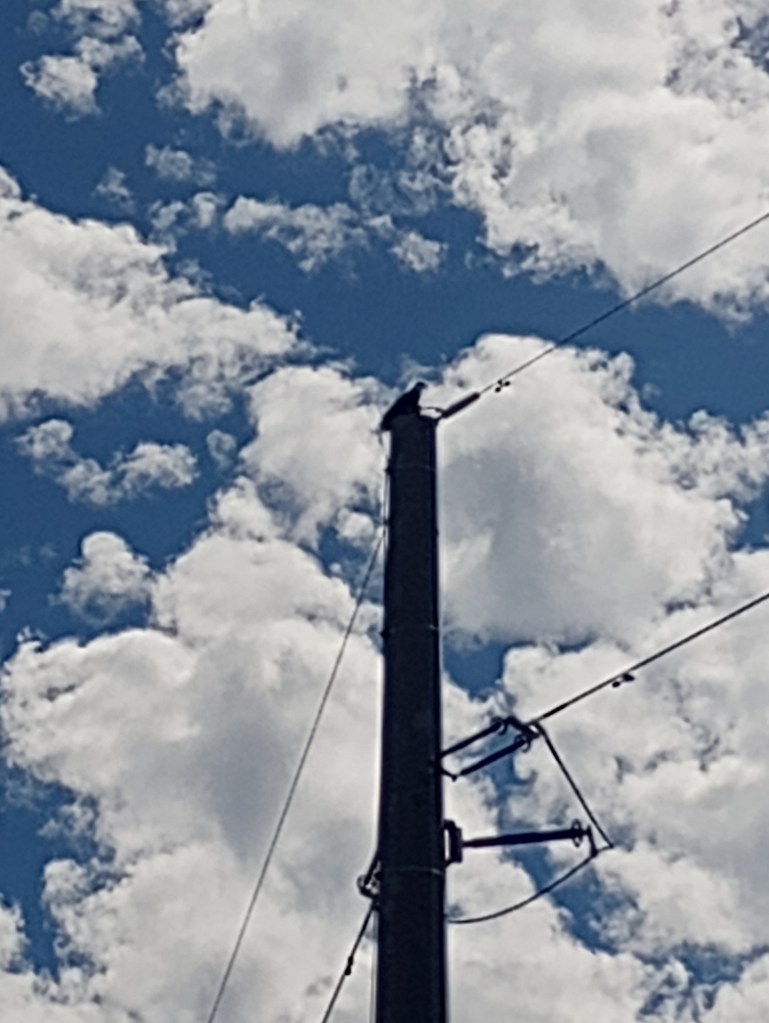
We also had a special visitor this week. It’s the first time I’ve ever seen a Bald Eagle at the farm. When he first flew by, I thought it was one of the Turkey Vultures we see daily. When he got closer, I realized what I was seeing. He was a majestic sight as he flew to perch on the giant utility pole at the south end of the farm. I tried to get a good picture but honestly, I’m not much of a photographer and I couldn’t get the light right. What you see is what you get unfortunately. I tried later when he was by the river, but he took off before I could capture a good image. I hope he finds us a good space to hunt at Opal’s Farm. We’d love to have him back.
We’d also love to give a shout out to all our volunteers returning after a long winter! The warm days we’ve experienced have brought some our old friends out and more are coming. We hope you can come enjoy Spring planting with us.
I get to see the gorgeous weather outside my office window, but I’m reminded that it’s only March 3rd. North Texas weather has a way of fooling everyone into a false sense of “Spring Fever”. The last frost date is supposed to be March 18th so maybe, just maybe, Spring is setting in…
A couple of weeks ago, my Monday morning meeting ended early, so I sat at the Philadelphia Airport waiting for four hours for my plane home. I’m not good at sitting but I have little choice over the next seven hours or so. It was nice to catch up on a few things, but I prefer the open fields and growing plants to rows of chairs and sitting in an airborne cigar…
I was here to attend the Black Urban Growers National Conference, or BUGs as they call it. Philly has a strong urban agriculture movement with many farms and community gardens dotting the city. They even have a Director of Urban Agriculture as part of the Parks and Recreation Department for the city government. It was great to make some connections with folks here. Hopefully, we can begin to move city government in Tarrant County, Fort Worth, and the surrounding cities to move in a positive direction for urban ag and community gardens. Jesse Herrera, Linda Fulmer, and Grow SE have moved us a long way but there’s so much to do to make Fort Worth favorable to urban agriculture and eliminating food insecurity.
Six cities currently have Urban Agriculture leaders in city government – Philadelphia, Atlanta (whose director also spoke at BUGs and was the first city in the nation to appoint a director), New York City, Detroit, Austin, Boston, Seattle, and Portland. These are also areas where there are strong food policy councils. However, each agreed that community member advocacy was essential to the formation of urban ag programs. These positions work through the mayor’s office, sustainability offices, parks, or planning departments. While Tarrant County has a food policy council, they need support from our community to have influence over policy decisions at the county or municipal level. We need is citizen support to drive progress forward for urban agriculture.
Why Urban Agriculture?
There are three primary reasons for establishing urban agriculture policies in Tarrant County municipalities – the number of food deserts, public health, and supply chain issues.
In 2020, NBC5 news reported that Tarrant County was one of the Top Ten counties in the country for food insecurity ( https://www.nbcdfw.com/news/local/fighting-hunger-urban-farming-in-fort-worths-food-desert/2292808/ ). Moreover, the USDA identified over forty areas in Tarrant County that qualify as “food deserts” – areas that are over a mile away from a grocery store. Food “desert’ is something of a misnomer. Food apartheid represented the concept far better as most of these areas are in lower income areas or communities of color. Urban agriculture and farmstands or farmers markets can make a significant impact on accessibility to fresh food in these neighborhoods. It can be costly under present urban farm and garden ordinances to build infrastructure needed for urban ag.
Public health is drastically affected by lack of access to healthy food. The zip code 76102 is the unhealthiest zip code in the state of Texas. Life expectancy is 66.7 years old – twelve years below the national average ( https://www.star-telegram.com/news/local/fort-worth/article244137362.html ). While lack of access to healthy food is not the only reason for poor health outcomes, it is certainly the root of the problem. In the Southside, Morningside, and Hillside communities there are only a dozen convenience stores that only sell snacks and highly processed canned foods lacking nutritional value. Locally grown, nutrient-dense fresh vegetables help the body’s own defenses against heart disease, high blood pressure, diabetes, cancers, and obesity that lead to shorter lifespans and higher medical costs. Costs borne by all of us.
The COVID pandemic revealed serious flaws in our present food systems. Who doesn’t remember the higher food prices and empty store shelves of many items we use every day. Breaks in the supply chain have serious consequences for the retail grocery stores. Our food travels an average of 1500 miles from the farm to your table. To reach your grocer, it has to be picked before it’s ripe, sprayed with preservatives, shipped by rail or by truck to a distribution center and delivered to each individual store. It lacks the flavor and nutrient density so many of us crave. Locally grown produce is a solution to this problem.
Moreover, local urban farmers develop a sense of community around the local farmer’s market or farmstand. The community gets to know their local farmers and their neighbors better. “Screen time”
Is often replaced by real conversations. A sense of neighborhood pride replaces some of the isolation that often plagues our senior citizens. Opal’s Farm has been a member of the Cowtown Farmers Market for five years now. We’ve developed a loyal customer base and we’ve come to know our customers as friends. We’ve been an active part of our community, and many folks have volunteered at the farm as well as become our customers.
What Can I Do?
Access to land is often easier than we think. Learn about urban agriculture in your neighborhood. Are there any community gardens? If not, is there a place for one? Are there vacant lots, churches, or schools that might be good sites for a small urban farm or community garden. Are there local learning gardens to offer growing tips and support to neighborhoods? Do your local schools have school gardens that you might volunteer with? Is there a place to gather to bring local farmers and gardeners together to offer their goods and services to the neighborhood?
Find out what the urban agriculture and community garden ordinances (or if you even have them) are in your municipality. Is zoning an issue? Neighborhood associations are often a great place to start if you have one. If not, local code compliance or development departments can provide guidelines.
Here in Fort Worth, urban agriculture ordinances were almost non-existent and what we did have was more of a barrier than a help. A local initiative by County Commissioner Brooks Office called Grow SE brought local non-profits and urban farmers together to address this issue. Grow SE worked diligently to address and change the city ordinances that limit urban ag and have made it much easier to build the infrastructure to make it successful but – we have a long way to go!
Get involved with your local food policy council. Food Policy Councils were first authorized in the 2014 Farm Bill and re-emphasized in the 2018 Farm Bill. If your city does not have one, then start one. Here in Tarrant County, we are fortunate to have a council with working groups in urban ag and food waste (a significant issue as Fort Worth faces having to build the infrastructure for a new landfill). Food policy councils can have a major effect on local food policy and urban agriculture.
Contact your local city council member and make your voice heard. Attend city council meetings and ask your neighbors to do so as well. Talk to your local officials and let them know this is a big issue to deal with. Changing the food system and delivery to your table begins at the local level!
I’m excited to be home and to continue our Fall growing and prepping for next Spring. I’d love to have you come out and start your urban agriculture journey with Opal’s Farm. Come see the possibilities for positive change here in Fort Worth and Tarrant County. Bring your kids. Kids (and unfortunately many adults) have no idea where their food comes from. Once they learn how good food is grown and distributed to our communities, they get excited to be a part of the process. The fresh air, vitamin D, and “playing in the dirt” is great for them (and for you!) Come and see!
Good Morning and Happy Martin Luther King, Jr. weekend from Opal’s Farm. It’s been a great week and we’re taking a deserved day off today. Amber has been hard at work preparing our tomato beds and planting some of the blocks already. The weather has been so up and down that the plants might make an early Spring market!
I’ve been madly preparing the beds for our TCU/SSARE research project. Dr. Omar Harvey, the professor in charge of our grant, has done so much to help us find solid numbers to determine best practices and help us direct our resources in a strategic manner.
We’ve also had some great volunteers over the last couple of weeks. The National Charity League, the Young Men’s Service League, and the Fort Worth BaHa’I Faith Center did an outstanding job building beds this past Saturday.
We’d also like to thank Shelly Young with The Hills Church. Ms. Opal and I were on a panel yesterday talking about food insecurity and what steps each of us can take to address it in our community. Shelly did a great job putting this all together and we’d love to thank the Unity Builders ministry at The Hills for having us.
I went to bed in 2022 and when I woke up it was 2023! That’s how it is for an old farmer. I rarely make it past the ten o’clock news, so I haven’t seen the “ball drop” in years. I hope everyone had a super News Years Eve celebration and wish each one of you a happy and blessed New Year.
I’m starting the New Year right by heading to Opal’s Farm to take advantage of the seventy-seven-degree January 1st here in North Texas. Rain is forecast for tomorrow, so I’ll make “hay while the sun shines”. That’s the way it is here. Christmas week was the severe winter storm that crippled most of the country. Now it’s Springlike for a few days and there’s much work to be done. Spring planting starts in six weeks.
The last two years have been difficult for Opal’s Farm. The weather has been a run between extremes – from the historic freeze of 2021 to the drought and extreme heat of 2022. Rain and lingering summer heat made for arduous fall planting. The recent winter storm, with its sixty mile an hour winds, blew the covers off the low tunnels and most of the fall/winter crop suffered freeze damage. We probably won’t be able to go to Cowtown Farmers Market this month, but we look forward to seeing you in February.
Extreme weather is becoming the new norm as the climate changes. We’re learning to adapt with new cultivars and vegetables that tend to be heat and drought tolerant. We’ll be bringing some new varieties of veggies to market this year. We are finally able to get some transplants started indoors so harvest will be earlier and more abundant than in the past. We’d also like to thank David Cole, Adjunct Professor of Horticulture at Tarrant County College NW Campus. He and his students will be starting our tomato and pepper transplants again this year. We continue the work of organically farming and building soil health. We’re looking forward to the New Year and we hope to serve more fresh, nutritious produce to our community.
We may have woken to a chilly morning on Saturday, but the sun was shining, and it was a great day for the first Phoenix Festival at Evans Plaza! Thank you to Brave/R Together and the Tarrant County United Way for a fantastic day of vendors, events, and music for the benefit of the 76104 community. Thank you especially to Shawn Lassiter (and everyone at Brave/R) for putting it all together.
Opal’s Farm is happy to be a part of this effort to better serve our southside neighbors. CoAct was there, and Grow SE were represented by Black Wall Street, Ms. Jovetta, and Mind Your Garden MYG Urban Farm. Steve and Ursula Nunez (MYG) put on an amazing cooking demonstration that had many of our neighbors talking and buying fresh, nutritious produce from all the farms. We are looking forward to the next Phoenix Festival!
We’ll be right up the road next Saturday for the Funkytown Mindful Market at Texas Wesleyan University with tons of fresh produce for our neighbors in Poly Heights from 11-2!